I’m very curious about using the damasks with modern and old roses. I have a Stanwell Perpetual which has spin genetics but I forgot it also has some damask in it. I was wondering if anyone has achieved any interesting results which they are willing to share or any advice on working with them?
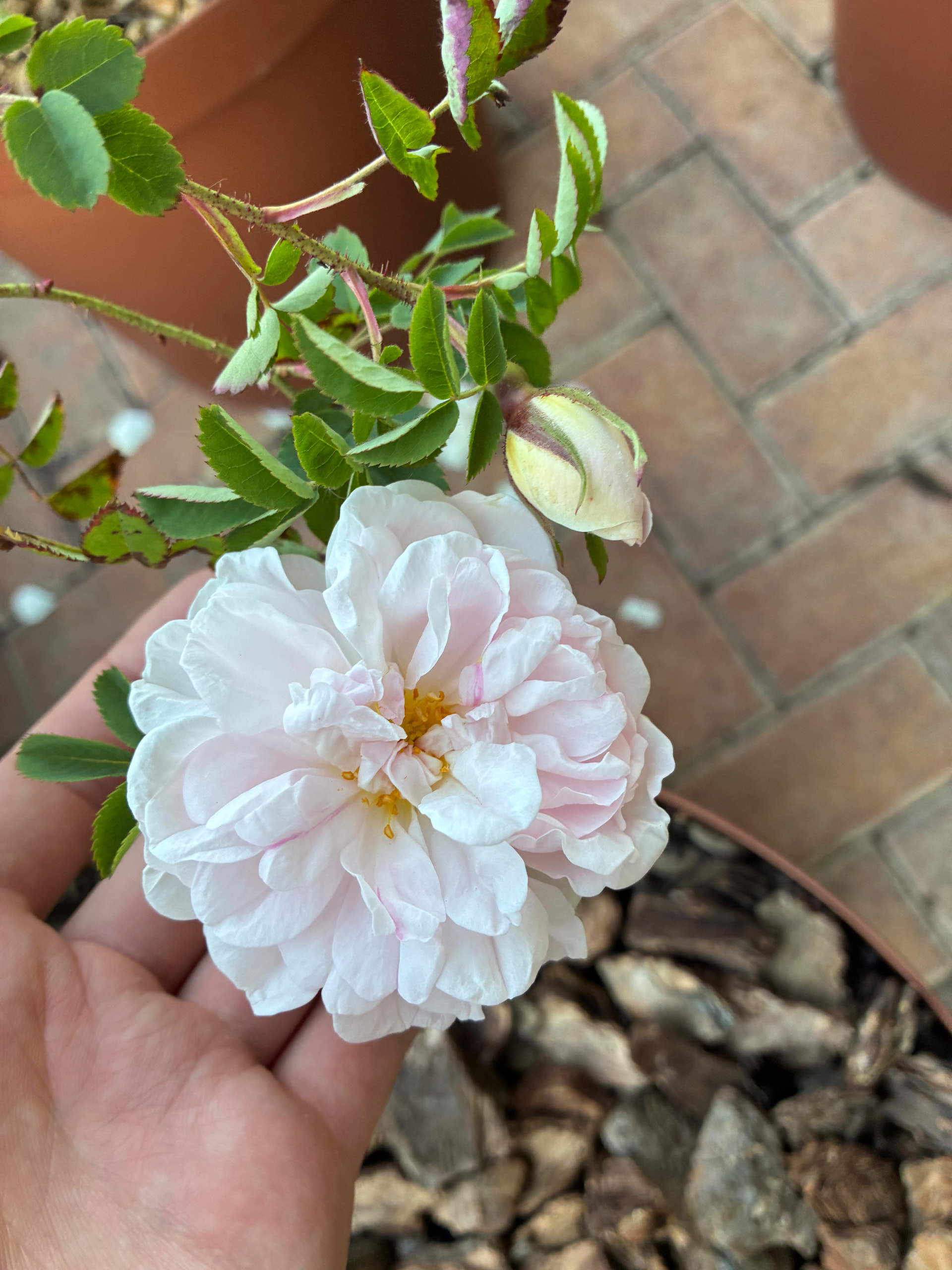
3 Likes
If you search “Stanwell Perpetual” here, there are scores of mentions in DOZENS of threads, discussing its provenance, genetics, and usage in various programs over the years (I only scrolled through the last decade). I would start there (ugh, homework), and then you’ll have all-new questions!
The basics: It IS fertile, mostly used for pollen. The rare seeds may take two (or more!) years to germinate. Throws a lot of once-bloomers, yet does carry one of the rebloom-alleles (181-variant?). Suckering, suckering, suckering.
Good luck!! I am working with descendants of ‘Suzanne’, through the Agriculture Canada breeding program hybrids made by Svejda.
3 Likes
Its half of my only success in 4 years which I call Goliath, it repeats 4 times a year and is semi fertile. I had 17 hips set originally, now I am down to 9 that haven’t aborted. If I can get any to germinate this next season I will be over the moon. The cross to get Goliath was rosa Indigo X stanwell 38 times. Only 4 times has hip set from it. Only 2 of those hips have had germinations from it and out of those 2 hips only 3 seedlings have survived by themselves… Those are all from 1 hip, one stopped growing for 2 years and was culled. The other is weak/unique and the other is aforementioned first great success of my breeding. Did I forget to mention it was the hip of my first cross. Now I know how hard it is for it to be successful… I count myself blessed. 6 stanwell flowers minimum in my climate to get decent pollen and then it barely works. However if I can get anything from “Goliath” (it’s pretty large) then I will be the happiest man in the world. Last season I harvested 3 seeds from it, then I thought that I had germinated 1… It was mislabeling. Huge gamble this year, used a lot of pollen… Could be a painful end of the season.
Also David Austin senior apparently saw Stanwell and came to the conclusion he would breed old roses with repeat blooming due to that flower or as the story goes!
5 Likes
Madame Hardy and Ispahan are infertile. My large Ispahan shrubs have once set 2 small OP hips with each one or two seeds. These seeds were duds. Madame Hardy does not have male or female reproductive organs.
So as a tip. Find some really good pollen or seed parents. You want a mass of seeds to have the luxury to make a good selection in your seedlings. My old x new rose crossing have always had a very large part of sick, malformed or weak seedlings.
2 Likes
I read that Ispahan pollen is semi fertile with a good mother plant. “Rosa St Nicholas”
2 Likes
There’s not much pollen to be found, but good to know. Maybe I’ll give it another shot. But I like to limit the amount of non-repeating breeding stock in my allotment. It is the hard way to get a good rose from such a cross, but it can be very rewarding. Best of luck to anyone who undertakes 10+ year journey.
4 Likes
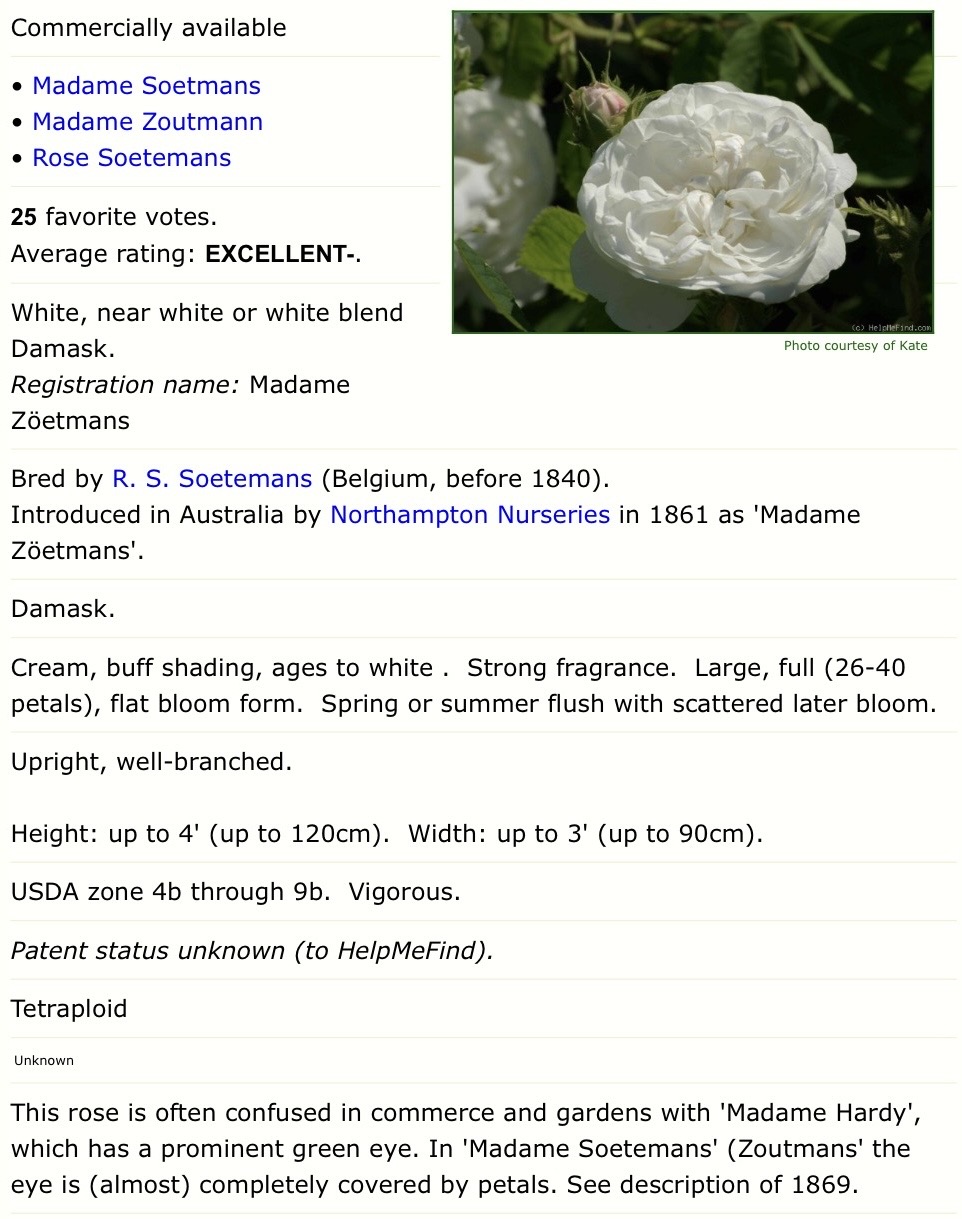
I’ve found this old rose called Mme Soetmans that looks alike to Mme Hardy and it is also a damask. I believe it is fertile, so I’m planning on using it for my crosses as well.
3 Likes
The scattered later flush could signal that crossing this rose with a repeat bloomers could give some degree of repeat in the F1. Does look stunning
2 Likes
I do not know if Mme Soutmans is fertile, but given that there are no listed descendants on HMF, I’d say the odds are against it.
Your comparison with Madame Hardy reminded me of a funny quote by Reynolds Hole, in his book “A Book About Roses” (highly recommended, if only for his wit and wisdom):
- “…Madame Hardy, a true white, and a well-formed Rose, but, alas! "green-eyed”, like "jealousy” — envious, it may be, of Madame Zoutman, who, though not of such a clear complexion, is free from ocular infirmities…”*
2 Likes
Unfortunately, I cannot comment on the fertility of the ‘Mme Zoetmans’ rose. The ‘Rosarium Sangerhausen’ describes this variety in its book Historical Roses as follows:
Growth habit: upright, overhanging, spreeding, 1.50 m tall, with sharp thorns and bristles. Foliage: green, slightly glossy, elliptical leaflets, usually 5.
Flower: in clusters, large and double, sometimes quartered or irregular, occasionally forming a rosette around the eye; the flowers sometimes fail to open due to balling.
Color: white with a pinkish sheen.
Fragrance: strong
Maybe these are a few more details that might be helpful.
2 Likes
I think I’ll still try Mme Soetmans for interest sake. If it struggles to bare anything I’ll anyway be happy I have such a nice rose so it won’t be a loss.
Some more damasks I can get cuttings of for interest sake are:
- Comte de Chambord 1860
- Duchess of Portland Before 1770
- Johnman’s rose (found rose)
- Petitee Lisette 1817
- Trigintipetala
1 Like
I have 3 crosses with Duchess of Portland. Two of which with ‘modern’ repeating roses. DoP has the hips of a Damask and her scent, but she is repeating in 2 or 3 flushes, making her something more than just a Damask. However her type of repeat is not compatible with modern repeat I have found. I also have a crossing with Comte de Chambord as father upon Pink Emily. Gave me some seedlings of which I kept one. All of them prone to PM, but the keeper far less so. I’m not sure if it repeats. It isn’t a juvenile bloomer. And it is less performing than I would hope for in a rose. I would have disposed of it weren’t it for my curiosity.
I’m now trying to get juvenile repeating offspring. I think the repeat of DoP maybe more resembling Rugosa / Kordesii repeat and could have the annoying habit of breaking repeat in coming generations even from well-repeating offspring.
Offspring is weak or non repeating for now.
3 Likes
That’s so interesting KarelBvn. It does indeed seem to be similar to rugosa repeat, in that it doesn’t necessarily combine well with modern repeat. Hmm. I might have to do some experiments next year between my damasks and my rugosas to see if there’s more compatibility there.
2 Likes
I tried working with Stanwell for a few years and never got anything from it. It won’t make seeds but its pollen will sometimes prompt hip formation on a female parent, but it rarely makes a seed. I have no records of actually getting a seed from any of these crosses to germinate.
If you can find it, Marbree is very easy to work with and makes both seeds and viable pollen.
2 Likes
Yeah as I say you need at least 6 flowers to get decent pollen. I have 3 of them, even then it’s not something you can easily stockpile. Even if you do, they probably won’t take. If they do, they probably won’t germinate. I have had 1 seed from 1 hip, which I tried to extract with embryo culture but damaged the embryo…
You’d be better off working with ‘Suzanne’, which is a far more willing parent.
1 Like
I have tried so so hard to source this in the UK. No dice!!!
What about Kazanlik or a true rose oil variety? In Coloma in Belgium they have several crossings from a Hungarian professor specialized in creating better rose oil Damasks via selection. They smell wonderfull. Maybe going to the roots is a path to explore?
1 Like
Interesting. Do you know the names of some of those Hungarian hybrids?
They were breeder codes. I’ve looked them up and found no reference online, not even on HMF. I’ve e-mailed the Hungarian university where the breeders were active, but got no response. I’ve no access to my documentation at the moment, but maybe In a few days I can look up what I had found about them. It has been about 6 years or more, when I did my little ‘investigation’.