Sorry, Rob, according to Kim’s version of Murphy’s law it’s going to be rangy, single, pink, mildly fragrant, and thorny. It will, however, have a almost-noticeable yellow eye.
I hope I’m wrong…let us know!
Sorry, Rob, according to Kim’s version of Murphy’s law it’s going to be rangy, single, pink, mildly fragrant, and thorny. It will, however, have a almost-noticeable yellow eye.
I hope I’m wrong…let us know!
I sure hope Murphy is wrong! I’ll let you know what turns up when it blooms.
I had quite a few seeds that were harvested in 2012 but not stratified until this winter in vermiculite and Calcium Nitrate solution. They were pretty dried out and I almost threw them out. But I had some vermiculite left over so I thought “What the heck” and put some vermiculite in each bag and threw them in the fridge with this year’s crop. Last night I discovered quite a few germinations in that lot:
White Dawn X Morden Sunrise
White Dawn X Julia Child
White Dawn X Prairie Lass
Rose de Rescht X Julia Child
Rhode Island Red X Unknown Cross (label was unreadable when harvested)
Mirandy X Unknown1
Mirandy X Unknown 2
White Dawn X Mixed Unknowns
Orange Ruffels X Prairie Lass
Orange Ruffels OP
Margaret Chase Smith OP
Once again reaffirms that holding on to the seeds another year isn’t always a lost cause.
Andre,
I’d be interested in hearing what turns up from your White Dawn crosses. I’m thinking of using WD pollen from a neighbor’s plant on some miniatures this season. Great crosses.
Hi everybody,
I still hope for the first seedling from my crossing. Last two years I didn’t have any success. Some hips from 2012 were accidently cut, hybridizings in 2013 on the other hand didn’t result any hips. In the meantime I play with OP seedlings. A week before Christmass 2013 I sowed about 200 seeds from an old unknown rose. First seedling appeared on 8th of March. Now there’s a crowd of about 50 of them. Some of them will be propriate material for hybridizing, maybe. Anyway, 50 seedlings are suitable reason to join you here, aren’t they ;-)?
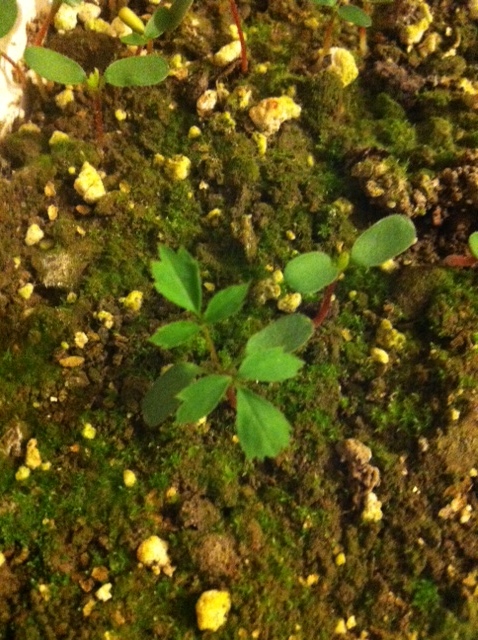
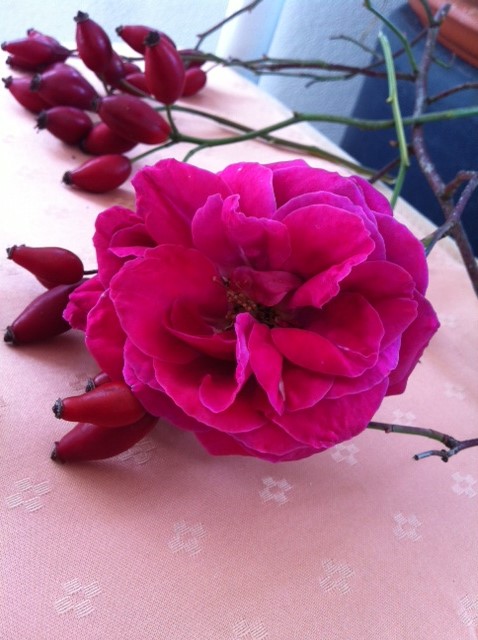
Welcome, glishill! Even without the 50 seedlings, anyone interested in breeding roses is welcome here. Maybe not spam-bots…
That’s an interesting mother, with those elongated hips. Apparently a repeat bloomer?
Thank you, Jbergeson. Don’t know about repeating yet, I took her hips in december 2013 when I saw her for the first time. Flower on the photo
was the last one and already a bit tired. It was fragrant, I can’t describe how, maybe it was raspberry. Yes, hips seemed interesting to me, too.
Congratulations, Glishill! I would say if you found a flower on it in December, that rose repeats.
Thank you. I suppose, yes, but I will surely check this year. I forgot to mention that it is thornless :-).
First germination for the year 2014, Seedling M1 N30
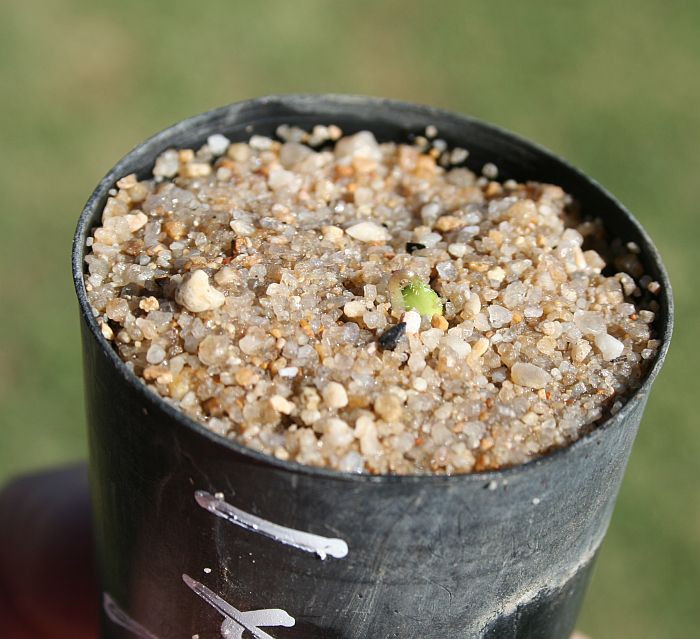
Quite a few more exciting crosses from last year’s (2013) crop have sprouted. Here is what they are and what I was thinking/hoping for:
Mirandy X Bright Melody - hopefully get a healthy, borderline cold hardy plant with large blooms in a shade closer to red than pink
Lafter X Morden Centennial - warm colors, descent hardiness, and hopefully healthy
Midnight Blue X Baby Love - purples, yellows, russets, singles, who knows what else
Midnight Blue X Black Baccara - Crossed for the color only. I am hoping for dark reddish-purple with few thorns
Midnight Blue X Yellow Brick Road - healthy shrubs with good branching. Probably purples, yellow and russets (I hope) with a few pinks.
Moonlight X Orange Ruffels - many petals, healthy, and some cold hardiness. MNLT should make it tall while OR should give it good branching - hopefully it does not climb
Moonlight X Pink Princess - health, many petals and branching from PP, height and warm colors from MNLT
Midnight Blue X Golden Unicorn - who knows, Russets preferred with purples and yellows too.
Morden Centennial X Baby Love - warm colors, descent BS resistance with some hardiness. Should have good branching too.
Morden Centennial X Dr. Brownell - Dr. Brownell should give me something thornless, cold hardiness from MC. Disease resistance should be average. Warm colors
Morden Centennial X Maytime - Healthy and cold hardy pinks
Morden Centennial X Yellow Brick Road - healthy with good cold hardiness and yellows and apricots through pinks
Night Owl X Alexander MacKenzie - tall with good hardiness and health. NO consistently produces completely to nearly thornless plants.
Night Owl X Dortmund - healthy and descent hardiness. Should be climbing
Nigrette X Joyberry - Yep, I used that Nigrette. No expectations but I am very curious to see what comes out of this one
Nuits de Young X Cuthbert Grant - Who knows what I’ll get. Not expecting moss but I do want the color and form of NDY. Attempting to add repeating gene to old European roses
Nuits De Young X Midnight Blue - hoping for a rich color. MB produces thornlessness many times so I am curious to see the effect on a moss.
Nuits de Young X Fourth of July - rich purple stripign maybe. again trying to add repeating gene to the gene pool
Paloma Blanca X Lynnie - HEALTH!
Pearlie Mae X Baby Love - should produce healthy plants with apricot and yellow shades
Pearlie Mae X Dortmund - healthy and who know what color besides pink I will get
Pearlie Mae X Yellow Brick Road - healthy and apricot through shades
Will any of these expectations come true? IDK. But I am really excited about all these crosses I have coming up. It was the first year I put my three rules in place when planning my crosses - no more willy nilly pollen pimpin’ for me. It is encouraging that I am getting some good hip set (52.1%) and that my germination rate that I have calculated is currently around 10% and climbing by the day. I haven’t even begun to count the OP test germinations yet. I also love that I am getting some unusual crosses (the Nuits de Young crosses for example) to germinate. Now I just have to get all these sprouts to bloom - it would be nice if it can just warm up outside.
[quote=“andre carl”]I had quite a few seeds that were harvested in 2012 but not stratified until this winter in vermiculite and Calcium Nitrate solution. They were pretty dried out and I almost threw them out. But I had some vermiculite left over so I thought “What the heck” and put some vermiculite in each bag and threw them in the fridge with this year’s crop. Last night I discovered quite a few germinations in that lot:
Rose de Rescht X Julia Child
With Rose de Rescht I had a sprout after a three years. I’m very curious what flower come from this cross. In 2013 I made over 100 crosses with Rose de Rescht mostly as a mother . Unfortunately hips I have had collected were only a few.
I missed these, would you repeat them for us please?
Now that I think of it, I may not have even mentioned them on the forum but over a private message. Sorry about that everyone.
But to answer Don’s question, I formed three rules that I generally follow (I say generally because I do break them from time to time). The three rules to pairing up roses are: 1) No two varieties with similar ancestry back 3 generations (that would include pairing up close descendants with their ancestors); 2) No two varieties from the same breeder within 10 years; and 3) No combination of tender roses (so a tender rose must always be crossed with a cold hardy or semi-cold hardy variety).
The overall reason for these rules is really to make sure I am not just putting pollen on everything that has a bloom and to make sure I don’t end up with too many crosses. They do, however, serve other purposes that will help me obtain my long term breeding goals. Rules 1 and 2 promote genetic diversity and rule 3 promotes survivability.
To accomplish rule 1 I keep an excel sheet that lists the ancestors of all my roses going back 3 generations. When I think of a cross I want to do, I check to see if the two appear in the same column under a particular ancestor. If they do I reevaluate the cross. Species roses do not get put on the list and can be combined with any variety regardless of common ancestry.
My reasoning for rule 2 is a bit more complicated (so I hope I can explain it correctly) but it compliments rule 1. My personal opinion is that breeders, especially the more prolific ones, tend to form side blinders and go down one or two paths without much deviation. Because of this, breeders like McGredy for example, start to produce varieties that, while quite lovely, are a little too predictable over time. Many times this is because they continue to use certain parents, limited in number, that they get good results from. Rule 1 catches all these. Other times it is because they only keep the ones that have “the look.” So weather intentional or not, they lose diversity in both the genotype and the phenotype. The 10 year rule is used because I think a person’s goals evolve enough in that time to give a fair amount of phenotype diversity - again, rule 1 will take care of any lack of genetic diversity. I want my seedlings to be unpredictable because, for me, that is the joy in doing this. BTW, while I have yet to actively use my seedlings from any breeding program, I do exclude myself from this rule.
The third rule was implemented to address the number one issue for me – cold winters. True I want disease resistant roses too, but it is an issue I can work on as I go along. So I focus on winter hardiness. I grow a lot of tender hybrid teas, miniatures and floribundas and have pollen donated that originate from chinas and teas. The chinas and teas will most likely not survive a winter (especially the one we just had) and the HTs, Mins, and Fls require a lot of cover in the fall and drastic pruning in the spring. So I combine the tender ones with the hardy/semi-hardy varieties in the hopes of raising the tender up a hardiness level or two. BTW, when I say “hardy”, I am focused on cold hardiness.
The rules will be broken when I want to promote certain traits that will need to be distilled. I am not completely against enhancing recessive genes through interbreeding.
I hope this makes sense to anyone who reads them. There is no scientific basis for these rules (at least none that I have directly studied). For now, I just want to make sure I don’t limit myself to a one or two trait path. These are just my own thoughts and ways to address some of the ideas I have read on the forum. Maybe an article will be in order after awhile.
Hi Andre, if possible could you a copy of your excel spreadsheet on here as I like your ideas. If not could you PM me one please so I could work one out for myself.
Regards David.
These are interesting rules. Aside from the specific objectives for which they are formulated they are notable for the simple reason that you have, in fact, applied a philosophy to your breeding program.
I subscribe to the same school as you and others here do. I have only one rule, though: every cross must be intended to fulfill one of my breeding objectives. For me the best part of the day during breeding season is contemplating which pollen goes where.
To that end I wi-fi my 84-inch flat screen TV to my laptop computer, string it on the fence and just do look-ups on HMF as I go along…
Don, really like the way of philosophy you put on the table.
Last year for the first time I started to perform my breeding program. Introducing some rules I hope not to pollinate everything what blooms, achieve goals, focus on principled. I was doing pretty well - to the moment when the thought come to mind; why not to take a look at some issues more broadly! Finally this thought led me through 1024 crosses in more than 100 options. What connects to multiple records, marks the stickers, labels and so on.
Good thing is that until now germination rate is currently 16.1%. Dumps had taken 11 %, the best result I’ve ever had before. Maybe for the fact that in autumn time I have ozonized pots. A weak result seems to be the number of a good mature hips (32,9%). Following I present some of the cross that I did last year:
THÉRÈSE BUGNET X COMTE DE CHAMBORD
MORDEN BLUSH X FRÜHLINGSGOLD
MORDEN BLUSH X Rosa spinosissima var. hispida
(11FRÜHLINGSGOLD X LOUISE ODIER) X (HT050512 MORGENGRUSS X CONSTANCE SPRY)
(11FRÜHLINGSGOLD X LOUISE ODIER) X WINNIPEG PARKS
(11FRÜHLINGSGOLD X LOUISE ODIER) X MORDEN BLUSH
(12D ROTKÄPPCHEN X RUBY RUBY) X CLARION CAL
JACQUELINE DU PRÉ X MORDEN BLUSH
WINNIPEG PARKS X [ (12/11A MORGENGRUSS X LOUISE ODIER) X CHAMPLAIN]
(11E MORGENGRUSS X CONSTANCE SPRY) X [ (11E MORGENGRUSS X CONSTANCE SPRY) X RHAPSODY IN BLUE]
(11E MORGENGRUSS X CONSTANCE SPRY) X JACQUELINE DU PRÉ
(12H ROTKÄPPCHEN X RUBY RUBY) X PLUKOVNÍK ŠVEC
ROSE DE RESHT X (11E MORGENGRUSS X CONSTANCE SPRY)
ROSE DE RESHT X CHAMPLAIN
ROSE DE RESHT X WILLIAM BAFFIN
WILLIAM BAFFIN X R. ROXBURGHII
R. ROXBURGHII X WILLIAM BAFFIN
ERINNERUNG AN BROD X CAREFREE BEAUTY
ERINNERUNG AN BROD X LYDIA FREIMANE
ERINNERUNG AN BROD X WILLIAM BAFFIN
ERINNERUNG AN BROD X ALEXANDER MACKENZIE
CONSTANCE SPRY X CAREFREE BEAUTY
CONSTANCE SPRY X ALEXANDER MACKENZIE
PAPA MEILLAND X HENRY KELSEY
THE SUN AND THE HEART X JULIA CHILD
Some of the seedlings have already buds. Can anyone give me some advices how to provide on new varieties to HMF, please?
Don, you gotta get your voice recognition software up and running. You inspired me to try this:
“Siri, search helpmefind.com for The Sun and the Heart.”
It actually worked. Now I need to figure out how to tether my iPhone to an 84" flat screen that’s wired to a fence. Maybe that’d be easier with an Android and some jumper cables.
Lrowjewski, I’d have to say roxburghii x Baffin and vice versa are very interesting crosses. Have you gotten germinations? I don’t really know what roxburghii is like. It’s too cold here for it. I tried growing it in a pot but it didn’t thrive and I tossed it.
As I am in the youth of my hybridizing, I went completely philosophy free last year. It was so pleasing to go out early in the morning and pollinate freshly opened blossoms of R. virginiana that I ended up with metaphoric millions of R. virginiana x this-or-that-but-probably-itself seeds. I couldn’t just throw them away, could I? And what about the hopefully metaphoric thousands of non-remontant seedlings that will be at first glance identical to R. virginiana? Oh, well, I’m smiling just thinking about these problem babies.
I well remember the conscious choice to limit spreading pollen to those crosses with intentional goals. In my case, it was to (hopefully) limit the quantity of seed requiring space. I guess it worked? I imagine there could have been MUCH more than there was, but it still required increasing my seed table space half again. I still tended to over do, in hopes of generating some decent seedlings from those I could save from the vermin eating them. I was a bit too successful as far as seed quantity is concerned.
I would caution not to post every seedling to HMF, or any other site, for several reasons. First, should you obtain a result which potentially has some commercial value, prematurely posting it anywhere could begin your clock ticking, severely limiting your possible plant protection before it can be sufficiently tested. Just as importantly, though, server space is expensive. Filling anyone’s server with seedlings which haven’t already proven some importance or value can be expensive for the site and boring for other site users. If the results are impressive and it’s shown itself of some value and interest, perhaps it’s worth sharing with other HMF users. If it seems just more of the same, why add it to the database? I’ve listed a number of seedlings on HMF, but I’ve also kept a huge number off the list simply because I didn’t feel they were either improvements over the parents or they lacked any real garden or breeding interest. If you want to document every result, perhaps somewhere like Blogspot.com or some other blog or photo site might be better?
Adding plants to the database on HMF requires a breeder listing to the site. This can be obtained by emailing the Help Desk with your information. Once you’ve received instruction on how to add entries and have the breeder security approval, adding them is pretty simple.
I thought that this cross you might like it.
In my garden roxburghii shrubs are growing in the most shade corner. Habit not too tight. The leaves remind me leaves of mimosa what I particularly like. Blooms shortly about two weeks. Never were covered before the winter. Roxburghii survived the terrible winter 2009/2010 without protection. Although it may not exactly be as I said, for tall fence effectively protects it from the wind. The seeds I treated in two different ways. As a wild spacies after harvesting I have extract and dropped straight away to earth.With the second method I act in standard as we all do with stratification.To this day, there was no germination.
2014-03-27 15.44.14.jpg
