Hello,
I already opened 4 of 5 Hips from Lady Hillingdon Climbing. For example today:
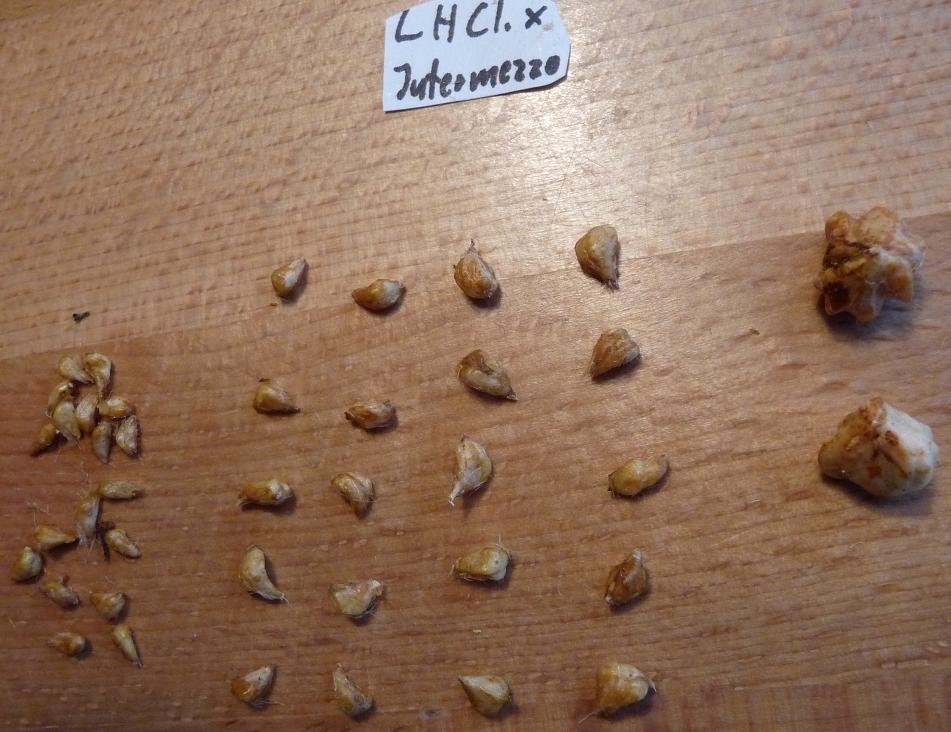
cross with Intermezzo:
and with Minerva:
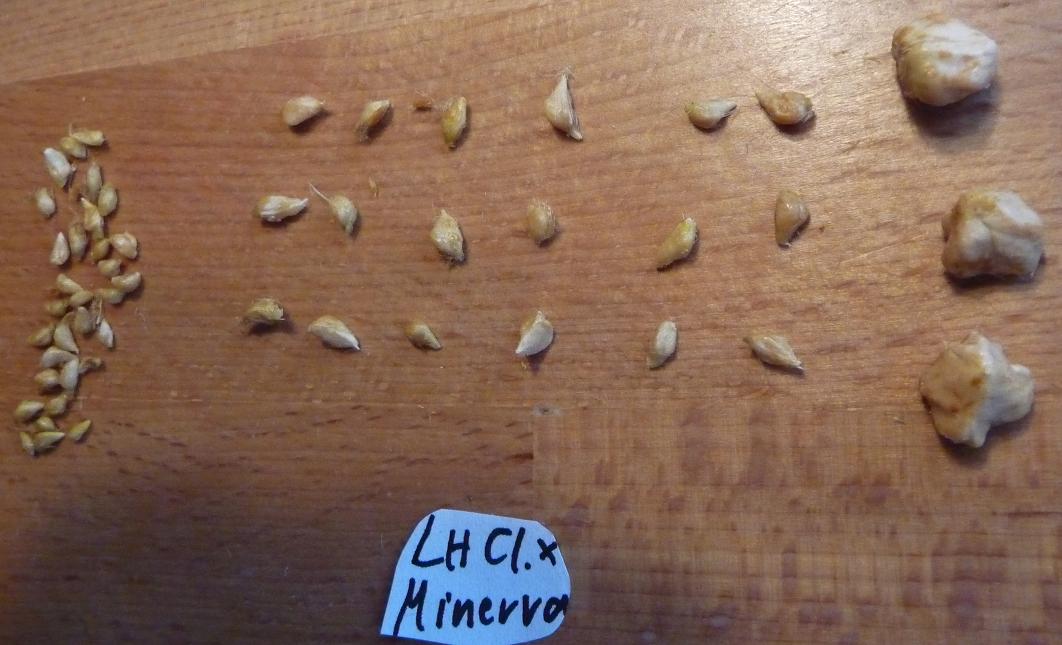
I already know that LH Cl. is triploid and the two pollen partners are probably tetraploid.
And I already know that the descendants could be diploid, triploid or tetraploid.
But is there any relation between the seed size and the ploidy of the seeds/descendants?
“I already know that the descendants could be diploid, triploid or tetraploid.”
Add aneuploid that is with an incomplete complement i.e.: 2n+1 or 2.
Add pentaploid, hexaploid… un to octoploid was found counting complex hybrids embrio cultured.
Viability is most often questionable.
…is there any relation between the seed size and the ploidy of the seeds/descendants?
None as gigantea or chinensis seeds are the largest at species level. Both are diploids…
This said the bigger ones are monsters and often the smaller are failed ones
is there any relation between the seed size and the ploidy of the seeds/descendants?
Not usually. Everything about the seeds except the embryo are completely maternal. The pericarps actually develop fully way before the embryos grow into them.
Embryos are a different story. Size follows ploidy but not by a whole lot and there’s enough variability that it’s impossible to use embryo size as a marker of ploidy.
The huge seeds in your pictures have embryos the same size as the small ones (if any have embryos at all). The pericarps are just more biggerer.
When you get into megaploidy like moyesii or praleucens then you really do see a difference. They have big seeds (not huge) but have monster embryos.
thank you!
But when I sow them, I’ll write on the labels where I have sown the big ones and where the smaller ones…
Well, the smallest ones probably do not have embryos at all, as Pierre said.
Usually the really large seeds come from hips with few seeds in them. I suppose the plant can put more of its energy into those fewer seeds and also the seeds have more room to grow so can get quite large.
10 years ago I germinated some seeds from a suspected triploid (I didn’t know for sure at the time, but confirmed it latter) and I just germinated the larger seeds in hopes they more likely would be tetraploid. I didn’t have any way to check the offspring for their ploidy so I can’t say for sure what they were. But I suspect they were tetraploid just by the way they grew. I know it’s not much help but I was thinking along the same lines as you. I didn’t pursue that line anyway and didn’t keep any of the seedlings.
Theoretically a triploid x tetraploid should only produce triploid and tetraploid offspring. But several years ago I put tetraploid pollen on triploid and got a number of seedlings. I measured the pollen grain size on of one of the seedlings this year and they were all in the diploid size range. I’m not sure how that happened. It could be an OP seedling from a diploid pollen source or it could be that the tetraploid plant produced 1n pollen and thus the offspring was diploid.
All seeds on the photo were in one hip, on the second photo too. So there was not so much space, the same space for alle of the seeds.
Usually I pollinate 2 times on two days. Is it possible, that the larger seeds come from pollination No 1 the first day, when the “hip” was still “empty” and the smaller/medium sized seeds result from the second pollination the following day? Sounds strange, but is that possible?
I also think, that in the smallest seeds contain no embryo. But the medium sized, I’m not shure…
Always just assumed that the bigger ones were more mature and the littlest ones were less mature and probably wouldn’t ever germinate.
If this size of the seeds is typically for the seed-parent Lady Hillingdon Cl., than it would be “normal” that the seeds would get so large and that would mean, as you supposed, that all smaller seeds in those hips were’nt fully developed.
Perhaps.
This was the content of a hip opened a little bit earlier, same cross LH Cl. x Minerva, that one contained 6 very big seeds.
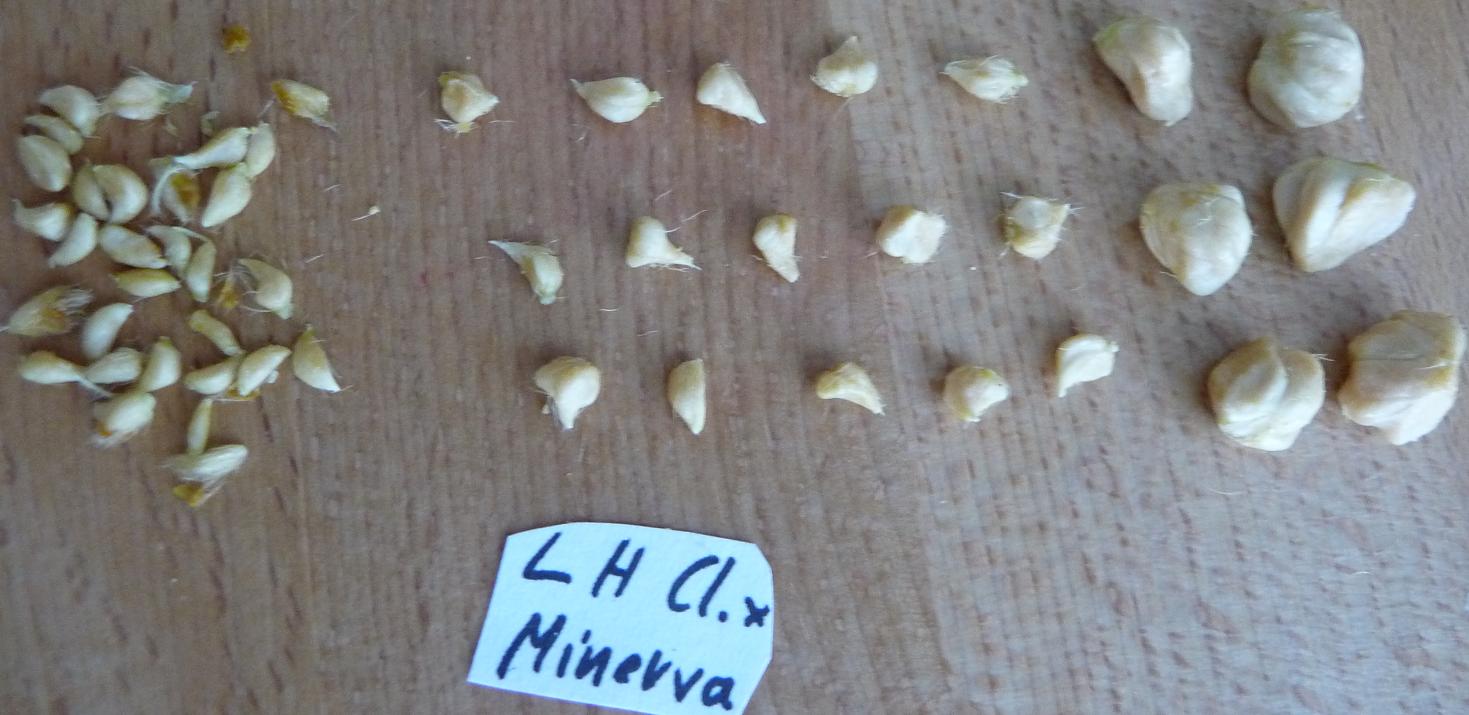
I’ll report next year what germinated, only the big ones, smaller ones too or nothing…
Unfortunately nothing germinated.
A few days ago I harvested such hips again, that contain very big and smaller seeds in the same hip. I’ll try again and will report, when there will be any germination.
Have you considered embryo rescuing? Many of my more difficult crosses prove successful. johannes
Do you mean embryo extraction? Yes, i did, there were embryos in the big achenes. The small ones I didn’t open, would be too difficult, too small.
The embryos were viable, became green and even developed a small root. But I have problems in cultivating them later on: When I put them into soil, they die afer a few days (happens with all small seedlings from embryo extraction, something is wrong with my method). Only one survived but stayed small and didn’t bloom.