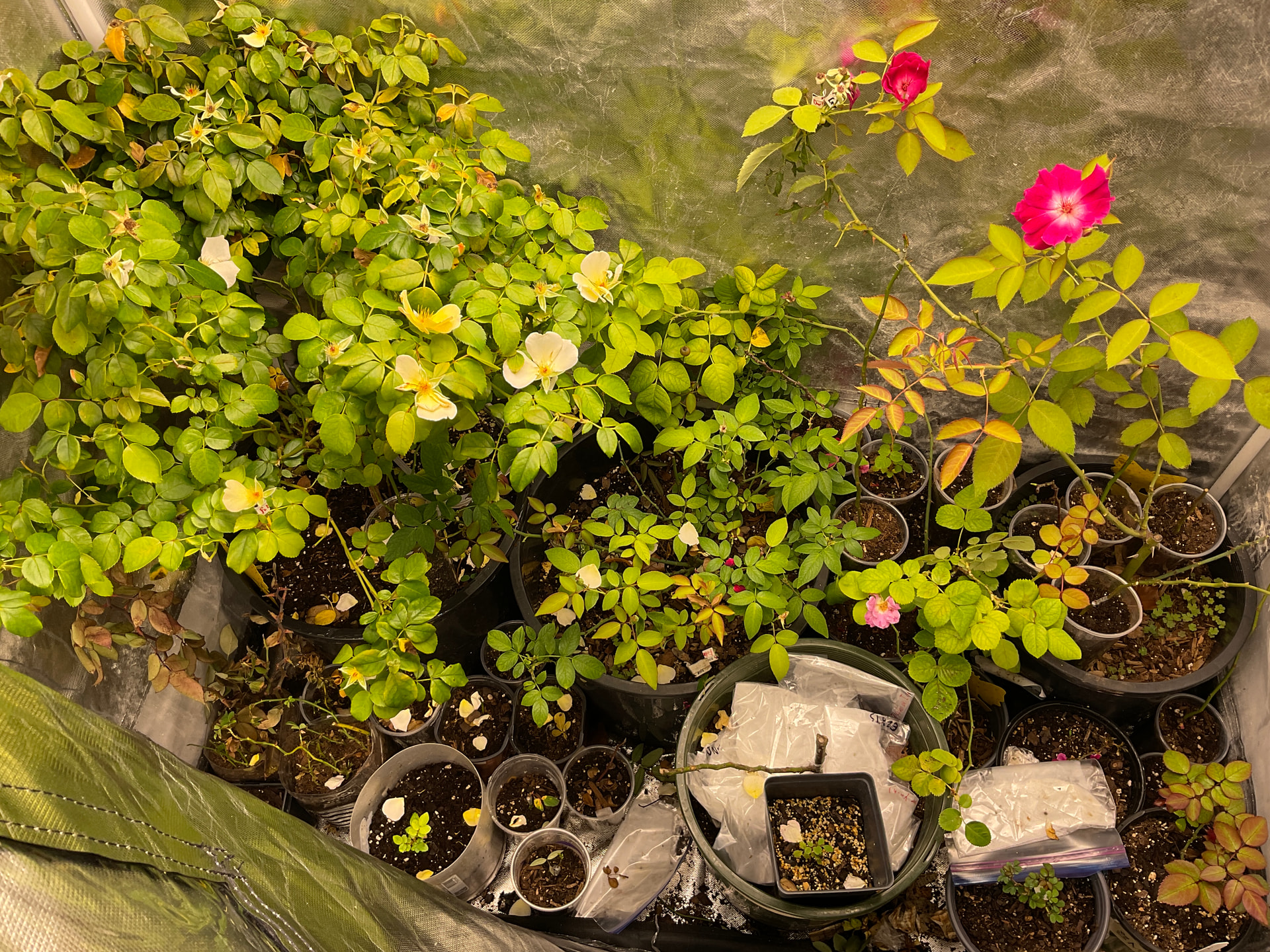
When do your hybridization efforts start each year? How early in the growing season do you start?

I live in Zone 5b and my LAST frost date was a couple of days ago (typically around mid-May each year).

My FIRST frost date is typically around mid-October.

The weather has now warmed up and my roses are finally starting to form their first blooms.

I would like to enjoy some blooms fully, then take stem cuttings for rooting after the blooms are spent. I want to take some cuttings first before allowing blooms to form hips.

And then I want to continue my hybridizing efforts from last year.

When is the latest that I can start hand-pollinating and still have enough time for the rose hips to mature, hopefully with viable seeds?

Again, I would like to enjoy some of these blooms without constantly worrying about the timing of their anther maturity or pollen receptivity.

Here’s a second question.

Half of my roses are in containers that will be brought indoors for the winter, inside an unheated garage. Is there any advantage to having rose hips mature on a POTTED rose that is brought indoors, or do the rose hips stop maturing once the rose goes dormant? The goal with my potted roses is to try and delay their dormancy a bit, maybe by manually bringing them out during the day and bringing them inside at night.

1 Like

I’ve usually read seeds are sufficiently mature by about 115 days after pollination. Perhaps more ā€œArctic hardyā€ types mature in shorter time? I don’t know as I can’t grow those types successfully in my climate. I don’t have a suggestion for your second question as it isn’t something I’ve ever had to contend with. I’m certain others here will, though.

2 Likes

Bringing them inside at night and put them back out during the day until the hips mature is doable, albeit tedious. Works great until you forget. Ask me how I know :slight_smile: I brought in a few roses with immature hips into a grow light under 24/7 lights and they turned orange in just a few weeks. If you’re just trying to buy a little time you could even just hang up a grow light above them in your garage.
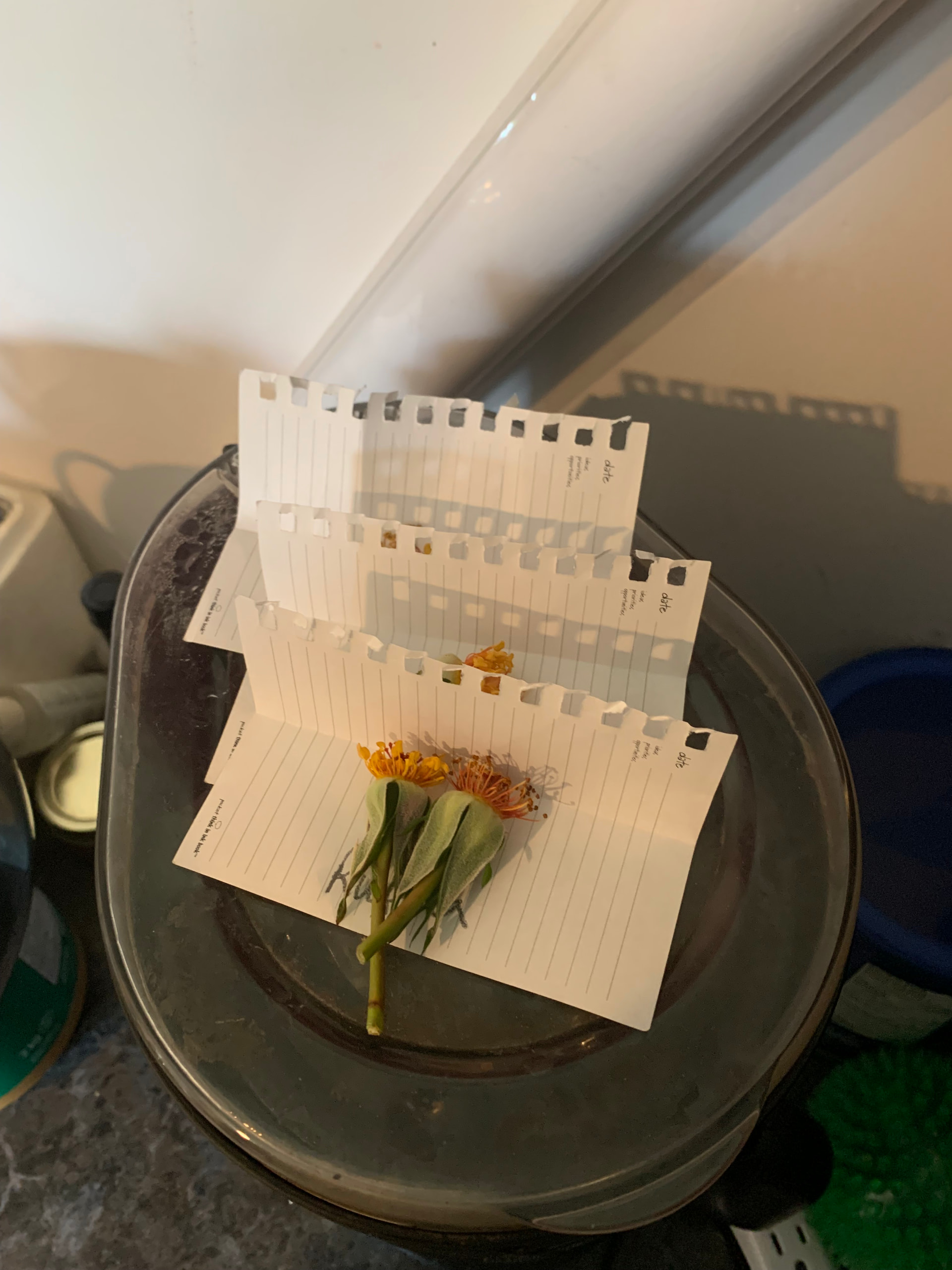
I keep two grow tents in my unheated garage and set the lights to turn on in the evening. The heat from the lights combined with the thermal mass from the pots kept the tents well above freezing even when temps dropped down 5 Fahrenheit. Granted I’m in 7b, but it did allow me to get a jumpstart on the season.

I potted up some bare root roses in the tent and they broke dormancy and grew out much faster than the ones I left outside. This was in late February when most nights were above freezing, but the increased light and heat allowed the grow tent roses to bloom much earlier, and I theoretically had enough material to take cuttings as you discussed. It allowed me to start off the season with a fresh pollen and a few hips already established while everything else was still waking up.

2 Likes

In 4b/5a I have been able to pollinate until about the 4th of July. I do collect and try to pop OP seeds after that as well.

The earliest of my modern hybrid roses have begun blooming, so I have cut blooms and harvested pollen from 'Abraham Darby, ā€˜Rugelda’, and ā€˜J. P. Connell’ just this morning, for use this week as their mates come into bloom.

The mini ā€˜Work of Art’ will likely have all three pollens put on it, considering the extremely-high germination percentage I had from it this year!

2 Likes

Arren, it has admittedly been 30 (blissful) years since I lived in a climate with real winters, but wonder why you might feel compelled to take green wood cuttings in your climate. My inclination would be to take fall cuttings from stems after they have largely gone dormant and have stored reserves for the winter. These can either be laid out and buried beneath the freeze line, or wrapped and stored in cool location until spring, whereupon you can take the now-calloused cuttings and plant them up.

Ripe wood cuttings, in my bygone experience, seemed for me to be more reliable and obviate some of your timing issues, no?

(Others with more real world experience with winters might set me straight! :wink:)

Kim’s ā€œburrito methodā€ describes an excellent approach to ripe wood cutting propagation.

1 Like

I don’t think something like that would be possible.

In the winter, the soil here freezes over completely. It’s like a giant icecube of dirt. The official freeze line (frost depth) is 40 inches here. That means that everything above it can and will freeze until mid-spring.

Most of my roses have major dieback, especially if they’re not planted against a building/structure. All the canes of my climbing roses (even the ones rated for zone 4, a zone below mine) die completely to the ground.

Even with recommended straw-and-burlap method as frost protection, there is significant loss.

The issue is the constant freezing and thawing, especially in late winter. The yo-yo weather warms up the roses just enough to kick them out of dormancy, and then the subsequent freezes kill everything.

There is no way I can propagate using this method. If the thick woods of established healthy roses get annihilated every winter, I don’t see how cuttings would survive.

What DOES work for me is to start rooting semi-hardwood cuttings in early summer and to allow those newly-rooted baby plants to grow a little bit during late summer and early fall, so that they can store enough energy for the winter. Then, those go dormant and are stored in my unheated garage until late spring, when they wake up again and continue growing as new roses.

It’s possible that other rooting methods do work in my zone, but it’s one of those things where I can’t take the risk.

With my own method, I get around an 80% rooting success (4 out of 5 cuttings make it), so I’m happy with those results and have stopped experimenting with other methods. I also end up with confirmed own-root baby roses before winter, so I’ll know how many plants I’ll have in the spring, and all they have to do is to continue growing.

Overall, it’s more convenient for me to start propagating in early summer than to wait for winter.

2 Likes

Harvest after first frost in the fall when leaves are falling and sugar stores are moving. Wrap and keep in cool (not hard-freeze) area like garage or crisper drawer of fridge if frost line is too deep.
I think you would be very pleasantly surprised at your success rate. This is typical ripe wood cutting procedure.

I’m more than happy to give it a shot (after doing my own method in early summer, just in case).

I have nothing to lose, especially knowing that those canes will die back either way.

I have seen some Russian videos on YouTube (with translated subtitles) where they cut thicker canes and wrap them in wet paper and plastic wrap, and then store them in the fridge. I’m excited to try that out over winter.

2 Likes

Do you always cut the blooms for harvesting their pollen?

I just use tweezers and pluck the anthers when they’re bright yellow and appear fluffy. I have to gently stretch the bloom open to access the anthers.

I put them in clear vials for a day, and the following day when they’ve dried up I close the vial with its lid and I furiously shake it like it owes me money. The pollen releases everywhere.

Then I either refrigerate it for use within that week or freeze it for future use.

1 Like

I was reading rose-breeding Wikipedia articles (as one does) about how some classic roses were hybridized, and one of the articles mentioned how a particular rose breeder build a greenhouse specifically so that he could keep his roses warm enough while the hips were ripening.

I’m finally building a greenhouse in the summer, so hopefully it will be useful in the fall for extending my roses’ growing season and the hip-ripening period.

The growlight-in-garage idea is genius. I think this will be my backup plan to ensure that my hips ripen. I have some spare grow lights, so I can definitely jerryrig something to cover most of my pots.

It will also be useful because my roses begin to wake up earlier in the garage, and they’re all leggy and yellow because it’s too early for them to go outside. By using grow lights, I can at least ensure that the new growth will be green and strong. Maybe I’ll even get blooms a bit earlier.

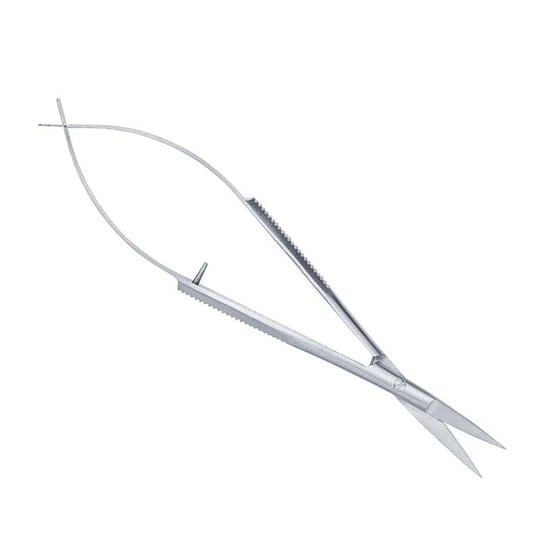
If I don’t plan to pollinate the bloom I want pollen from, then yes, I’ll cut it from the plant. Otherwise I will leave it attached to the plant and harvest the pollen from it. I use these. They’re stainless steel, made in Pakistan and used for jewelry and sewing. Rio Grande is THE most economical source there is. I’ve seen them packaged and labeled by sewing sources for $25 a pair (ALL made by the SAME Pakistani manufacturer). Rio Grande sells them for $4.99 with quantity discounts. Buy four or five as you WILL break one and lose another. I have several and am using the same pair now for the past seven years. To cut the anthers, you simply squeeze them together so you can hold with one hand and cut with the other, even small flowers till attached to the plant. https://www.riogrande.com/product/squeeze-action-4.75-straight-blade-micro-scissors/119341GP/?code=119341

Is there an advantage to cutting the anthers versus just plucking them?

I just use tweezers. I pinch the anther at the filament and then pluck it and drop it in my little jar/vial. Regular tweezers work great, but you can also get precision tweezers for exact accuracy.

For me, the advantage of cutting rather than plucking is speed and ease. If plucking works fine for you, stick with it. ā€œIf it ain’t broke, don’t fix it!ā€

Yeah you can get really strong, efficient grow lights for cheap these days, especially if you live in a state that’s legalized marijuana. Lots of people selling lightly used indoor grow equipment on facebook marketplace. If you’ve got the space and time, a grow tent will give you better light, heat and humidity, which should help the hips ripen faster. Even a small one can house a lot of plants and cuttings. This was my 4x2 this winter:

1 Like

Do I always cut the blooms I am harvesting pollen from? No, but it is certainly easier to do so! I let them sit for the day, until I can see pollen shedding, then use long & pointy tweezers to pop the anthers off onto the paper, then fold it into an open-topped ā€œenvelopeā€ and tuck it safely away for use later.

Ah ok.

For me, since the number of blooms is limited on each of my rose varieties, if I’m going to collect pollen from a bloom, I’ll typically remove the anthers with tweezers, cover that bloom with an organza bag to keep insects out, and then I pollinate it with either freshly-released pollen from any other variety or from previously-collected refrigerated/frozen pollen.

Ideally, I’ll have blooms available at the same time from the 2 roses I want to cross, so my process will only consume 1 bloom from each rose, being crossed in both directions.

I practiced all of July and August last summer on how to successfully do that without damaging the blooms, and I found it very fulfilling.

This year, however, I finally obtained some rose varieties with over 100+ petals, and I have no idea when blooms with so many petals become ready for anther-harvesting and pollinating. With blooms that have under 60 petals, it’s easier to tell at what stage of ā€œfullnessā€ the anthers will be ready.

I don’t know if I’m going to be successful with 100+ petal blooms.

Any tips?

Any tips for harvesting pollen from highly petaled varieties? Perseverance and experimentation. I’ve found some are more easily harvested when the blooms are quite far open, but not to the point the anthers are beginning to darken and dry out. Others can be easily ā€œdeconstructedā€ at the rather immature, closely closed stage. You should experiment to see what stage best suits what you’re intending to work with. Generally, those with the most petals yield the least amount of anthers and those you can dig out often produce little pollen. It may require a larger number of blooms to collect the amount you need to accomplish your desired number of pollinated blooms.

2 Likes

Does that ā€œmore-petals-less-pollenā€ observation apply to many of the David Austin roses with 100+ petals?

I’m excited to try with Bathsheba. She’s my only DA rose.

There are dozens of buds on her already and many are opening up right now. I would love to get some offspring of Bathsheba x Scentuous or Bathsheba x Peace or Bathsheba x Lavender Crush.

Have you noticed any patterns/tendencies for these types of blooms when they’re used as seed parents? Do they grow and carry hips successfully?

Would you recommend that I use Bathsheba as a pollen parent instead of seed parent?

Sorry for all the questions. I just want to temper my expectations so that I don’t end up with a completely-wasted hybridization effort.

Doubled petals are the result of a mutation where reproductive parts like stamens are ā€œconvertedā€ into more petals instead. At the higher end of the petal count this can result in roses being effectively self-sterile due to producing little, if any, pollen.

I don’t grow many except for a roadside old rambler and one interesting seedling, but I’ve come to appreciate the fact that I don’t need to emasculate or de-petal them. Just a generous dab of pollen when the stigmas become available and if a hip forms I can feel 99% confident that it was my intentional cross.