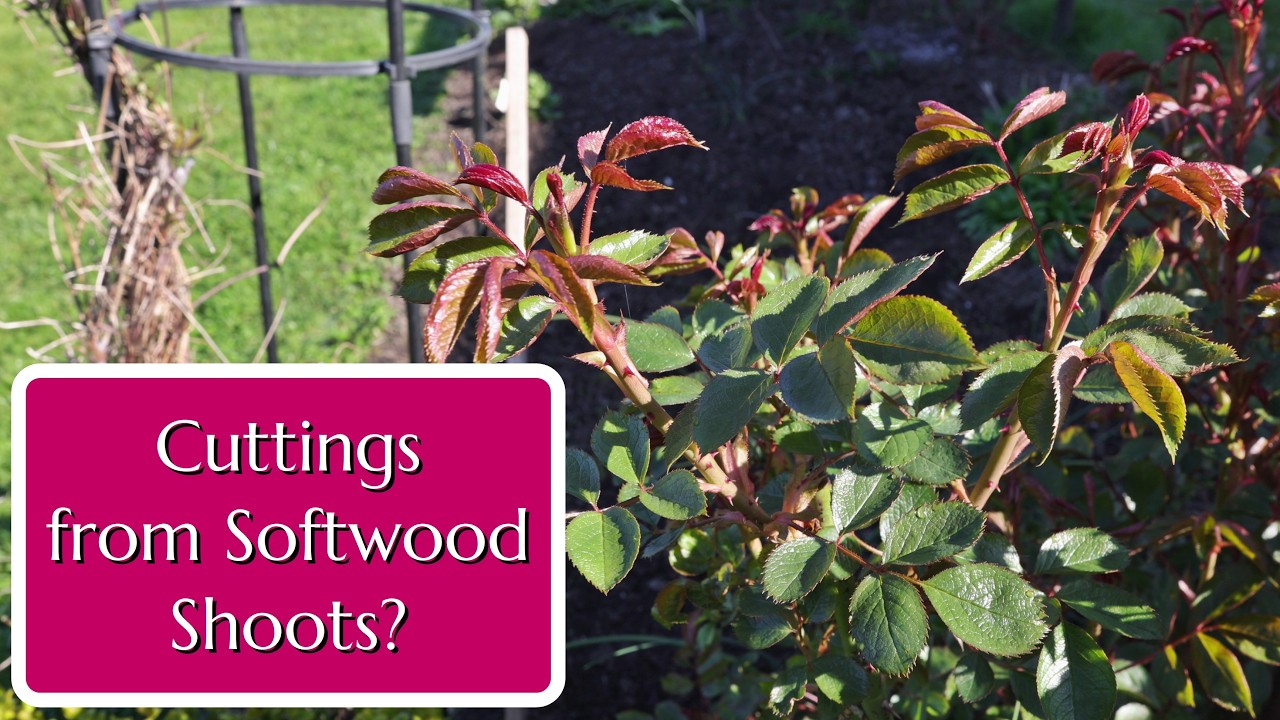
Roses sport frequently. Most often, the sports are degenerative. Of course you CAN propagate from pretty much any piece of the plant, selecting a stem from which a perfect flower has just faded allows you the knowledge you are propagating from material which will produce the exact flower you want it to deliver.
There is a wonderful old rose book, A Rose Odyssey, written by Dr. J. H. Nicolas, who was, for some years, the breeder for Jackson and Perkins. In it, he recounted …
A Rose Odyssey
Book (1937) Page(s) 14.
Several years ago there was a discussion in American Rose Society circles about the genuineness of the American stock of General Jacqueminot. I studied the question abroad and found at Reymond’s a line of magnificent everblooming General Jacqueminot, descendants of the original stock he had inherited from his Uncle Roussel, the originator. These had been improved almost to the status of a Hybrid Tea (sic) in floriferousness. We acquired enough plants from Reymond to rejuvenate our stock and the General Jacqueminot stock of Jackson and Perkins is of authentic French origin.
The rest of the section discussed how the HPs had been nearly destroyed through injudicious bud selection. The plants ran rampant and were shy flowering. The “improvement” in the variety was due to judicious bud selection.
Back in the very early 2000’s, I imported Eureka from Britain. The next year, it was marketed in the US through Week’s Roses. The British Eureka grew strongly while the Week’s plant was soft and “floppy”. I asked Tom Carruth about it at a rose event and his suggestion was that Week’s had produced the plants from soft, new growth, resulting in soft, floppy plants. Anecdotal, of course.
Mistakes in production occur all the time. “Ragged Robin” was the widely used stock in the US until about WWII when someone went to the fields to cut the next year’s root stocks and found vigorous shoots they found desirable for harvesting. The resulting plants grew exceptionally well in comparison to prior crops. Dr. Huey was found to make a superior stock for commercial production in the US fields and an accident resulted in the discovery.
When bud wood is harvested, the task is often given to lower cost employees who likely don’t have expert knowledge of the plants, but can follow directions to find the plants in the fields and cut the required number of buds. When you are given the task to bring in large quantities of buds from a variety, when you encounter long, strong growing canes, the natural inclination is to concentrate on those to shorten the time required to accomplish the job. You’d be surprised how often either root stock suckers or climbing mutations are harvested as the bush form of the requested variety.
So, there is, at least, anecdotal evidence that bud or cutting selection can influence the produced plant. At least by selecting wood from which the exact flower you desire has just fallen, you probably stand the best chance of obtaining a plant of it.