One pollen grain of 1/2 DNA only per one seed?

Oblivious question after 30 years, except l don’t know the simple answer, except seeds happen.

How does 1/2 dna transfer occur and where does dna contamination occur vs what was suppose to be crossed?

I believe there is the potential for hundreds of these stigma tunnel boring machines in a pollen grain - but each only have one set, of the 1/2 dna contribution to seed.

I have assumed one grain of what within carries 1/2 dna in the stigma transfer tube to ovary, each to separate target seed generating site.

My paradigm is one microscopic grain of pollen material gives one 1/2 dna in tube to one “egg” (other 1/2 of dna in seed) site equals one rose ( dna mutation or meiosis / mitosis weirdness too complicated for me). Ditching pollen now to avoid there’s thousands in it.

I assume whose pollen grain ( “male rose dna half”) transfer tube gets there first … wins for only one seed site.

Rest rejected that head to that same site ?

Only way l can see contamination working after crossing done.

A basic good simple reference to, if possible would be appreciated.

Let’s muddle it up! If the ploidy of both mates are equal, then yes, each seed should have half of one and half of the other, as long as they are even and equal (diploid X diploid, tetraploid X tetraploid. etc.). THEN, there are fertile triploids which do all manner of “fun things”. So, a diploid X fertile triploid might be 7 genes from the diploid with 7 from the triploid, or it could be 7 from the diploid X 14 from the triploid. A number of breeders have made good use of such oddities and they can be FUN.

Yes, probably. Once an egg is fertilized, it rejects other sperm (pollen). Sometimes weird things happen which aren’t obvious until you see the results.

1 Like

Big thanks, clearer for sure.

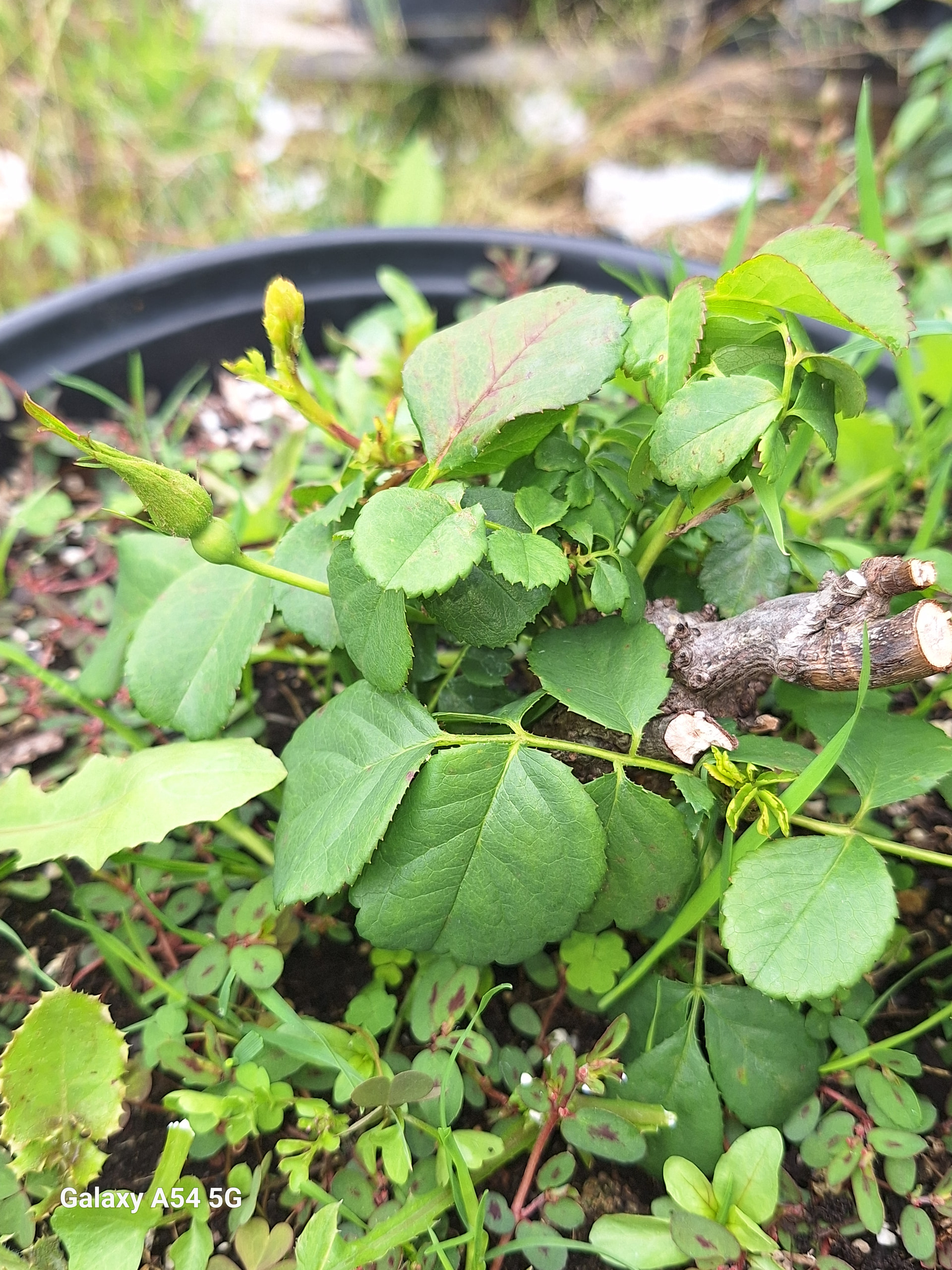
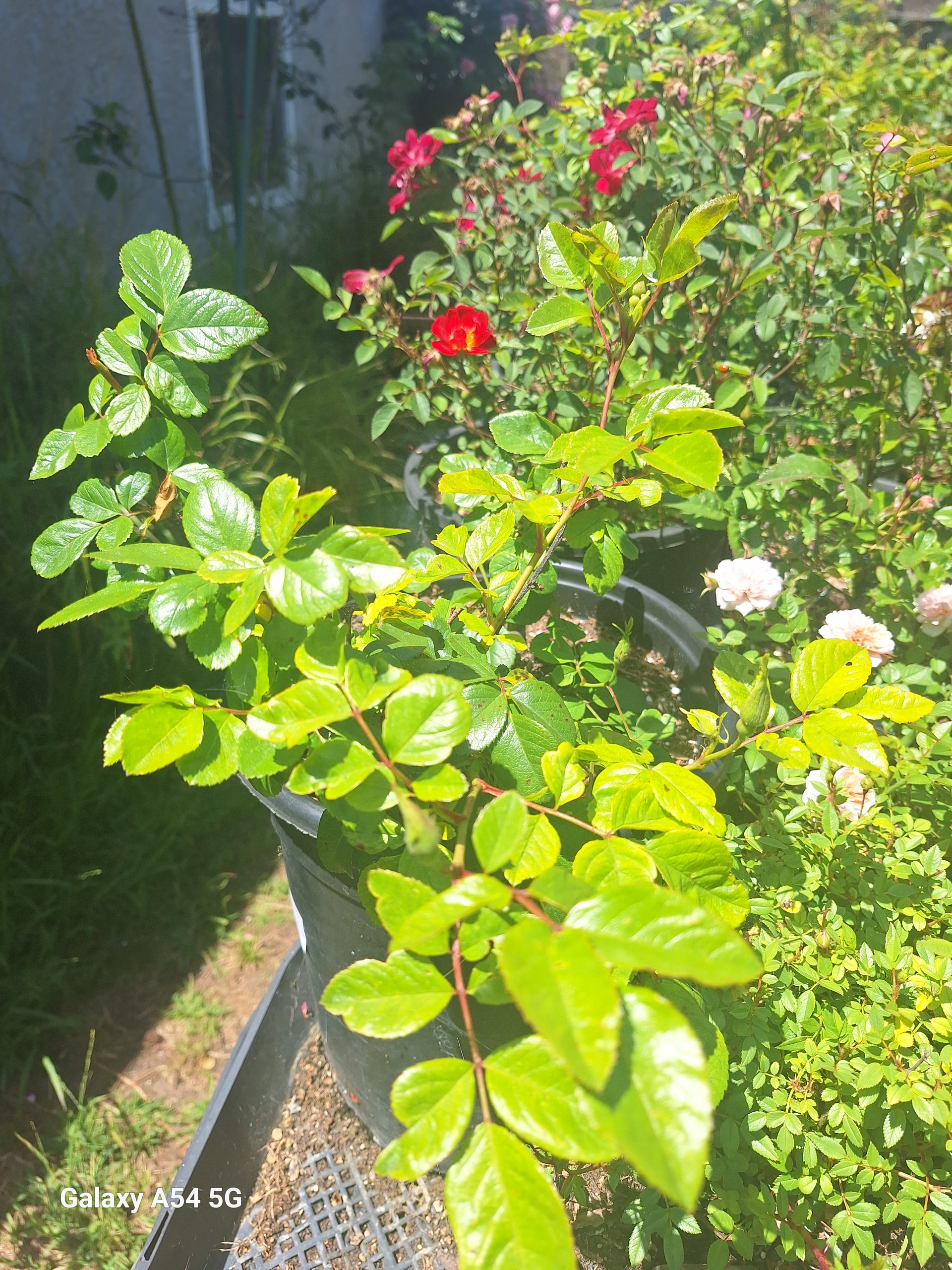
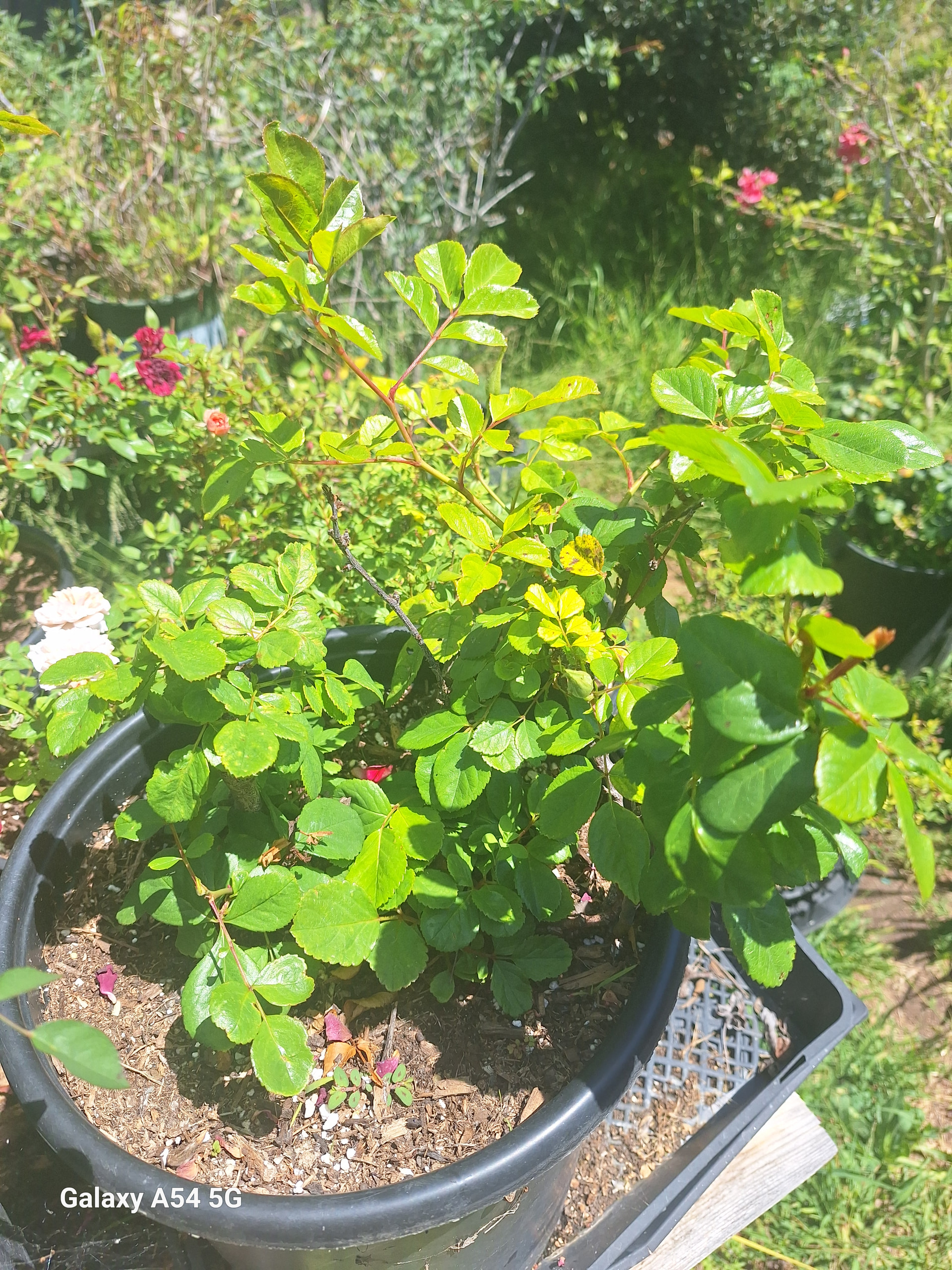
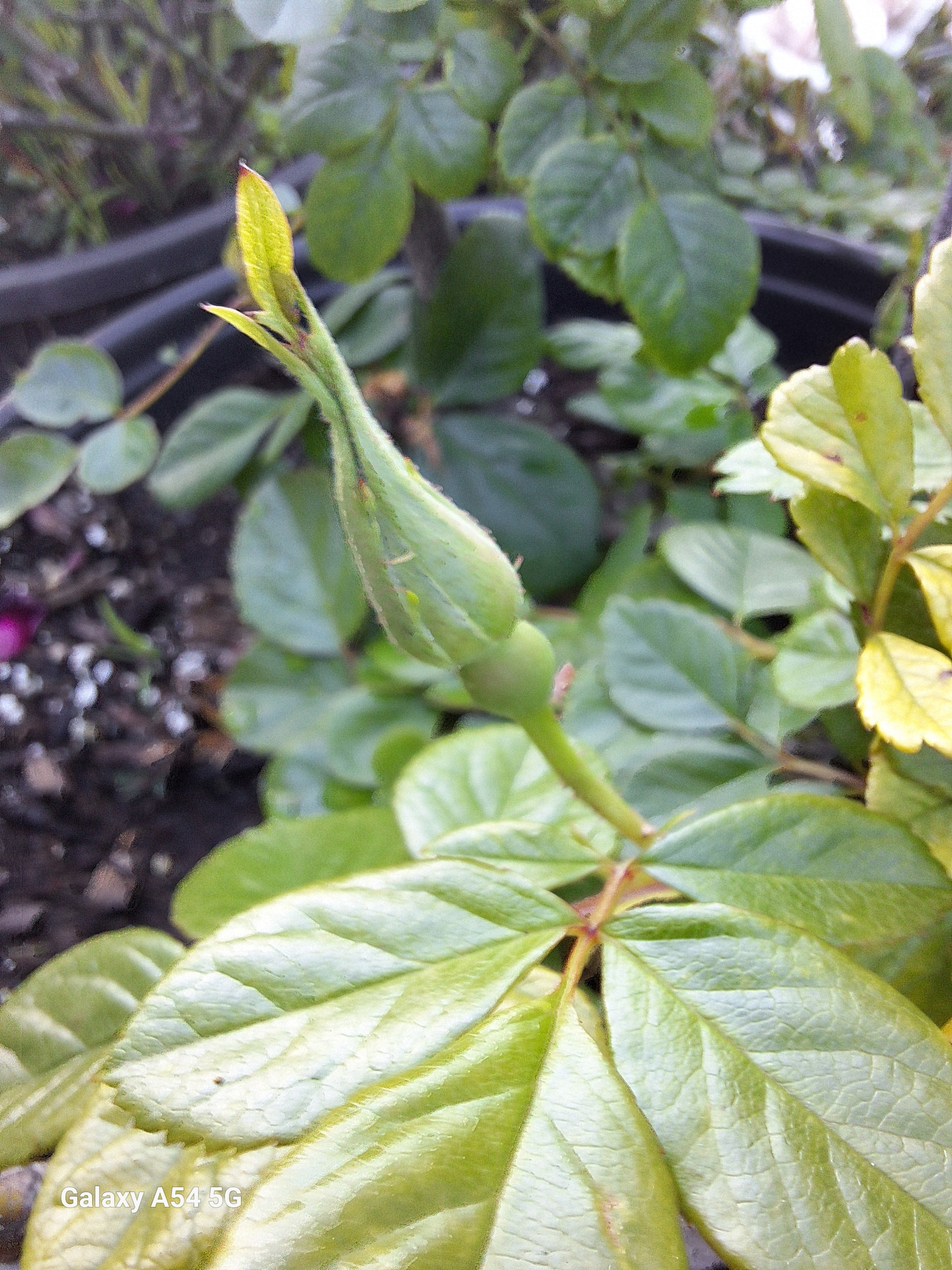
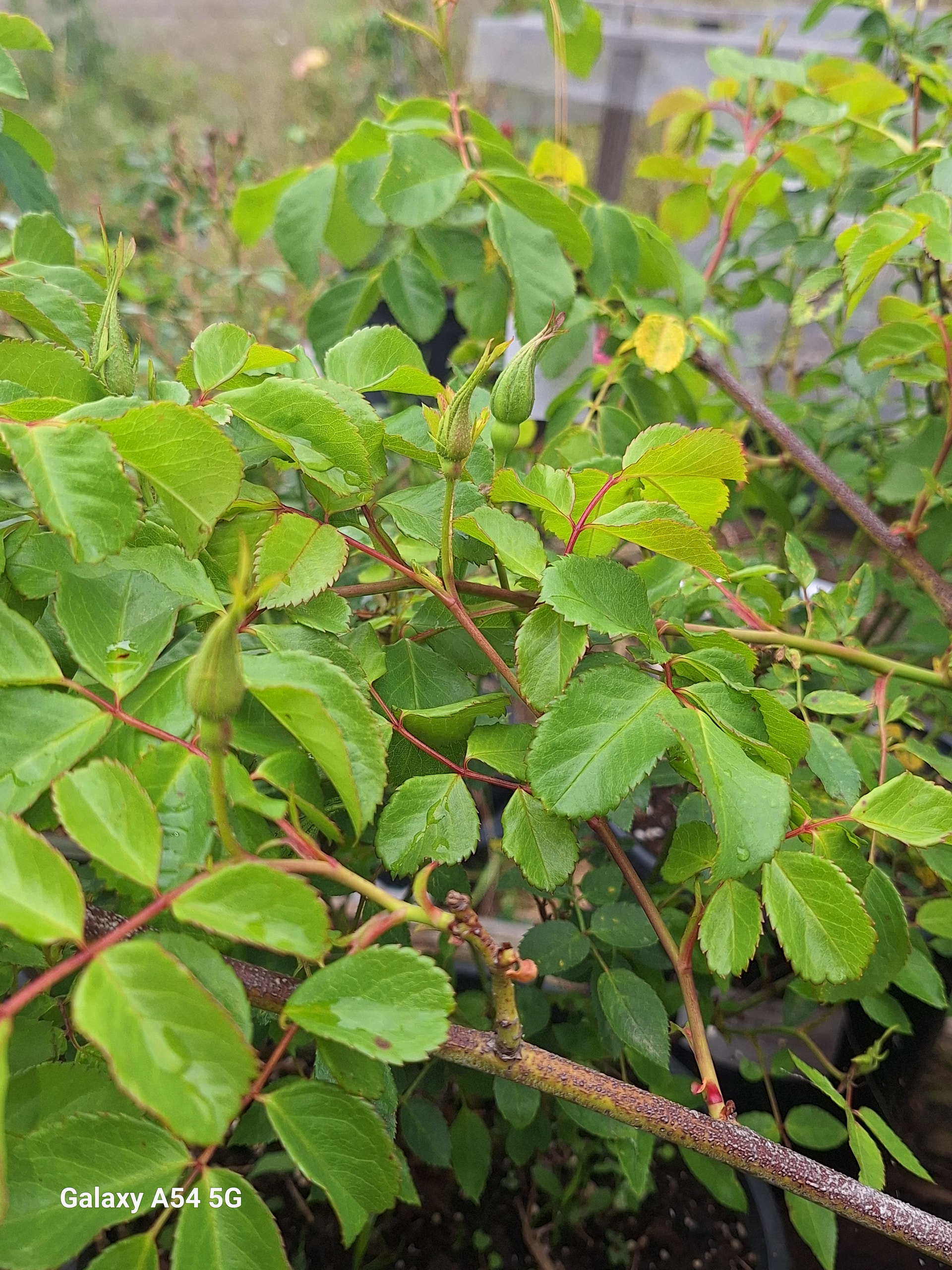
I am scratching my head about some seedlings, mainly from 2023 germination year and one in particular. The one l call my prize seedling, due to climate robustness and pm resistance. However l am beginning to wonder if a post person was involved in its genetics.

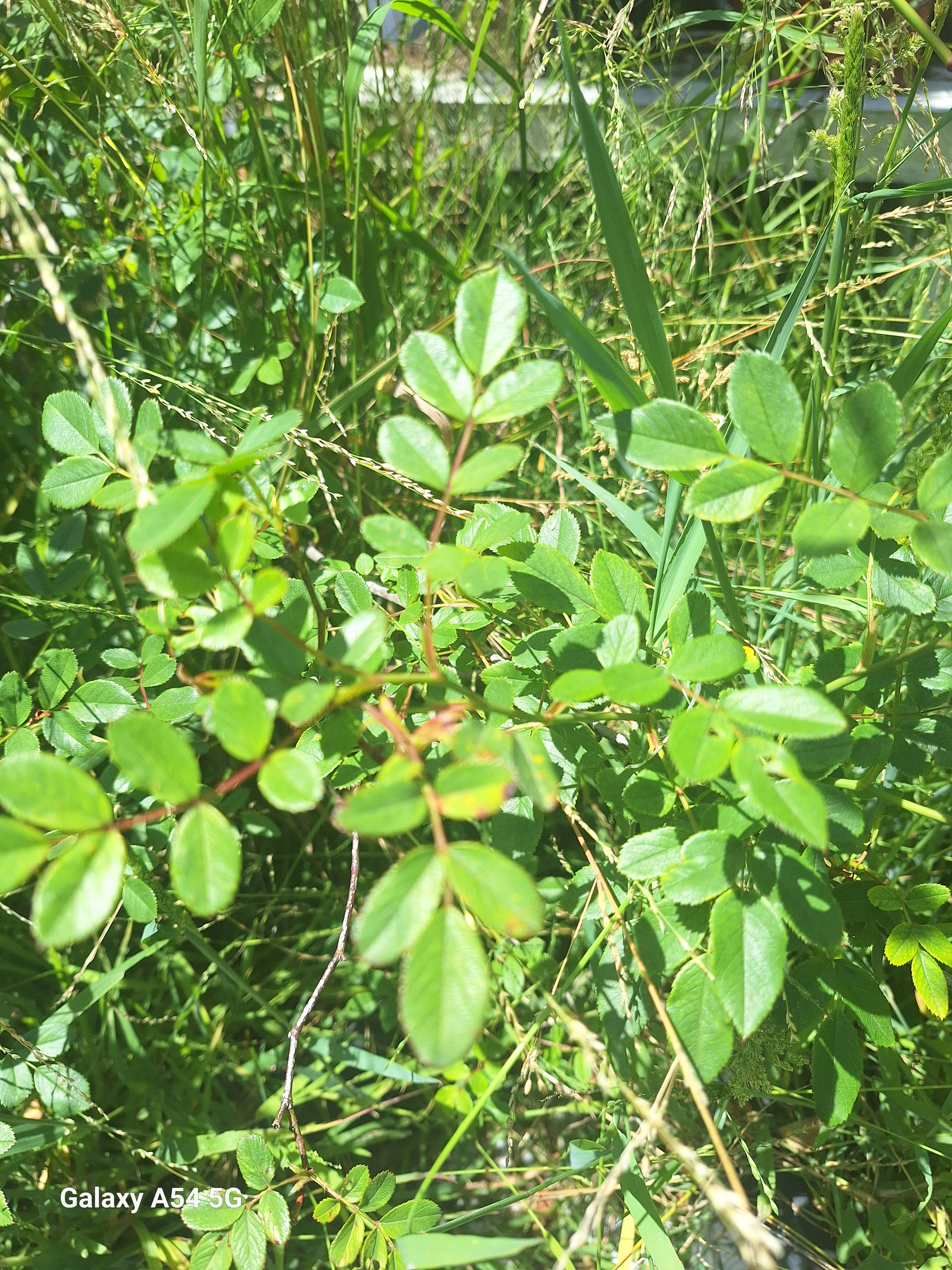
No matter how critically l look at my prize crossing, l see nothing, to imagined? similarities to the pollen/seed parents. It does have real tangential and vague similarities to the pollen parent. Mainly for leaf form and individual leaf count (7 to 9 leaves per leaf stem). But not an individual leaf on leaf stem (forget tech term).

The color is a different green shade with no distinct grey blush shading (like light dusting) of pollen parent. Green is like the seed parent but darker and thats it.

Bush form l call fountain shaped. The parents are not - one is (was) shrub shaped, the second l lack descriptors for it. Call it primative, robust, wild and going every which way. Canes stiff as a brick for the most part … also known sometimes as a species. Origins European nursery.

Canes have no middle parental ground or pole for form of prickles, numbers/density, geometry and location on cane.

Hardiness? Seems to depend on winter. First and second winter swore it was solid pollen parent influence until this spring. This year it cracked (under pressure). Though hardiness still good (my seed parent goes three winters only even with using an extravagant degree of protection). Odd as l believe this Pirjo hybrid comes from the Helsinki area or my hill in foothills is harsher.

Started throwing out starter canes this spring.

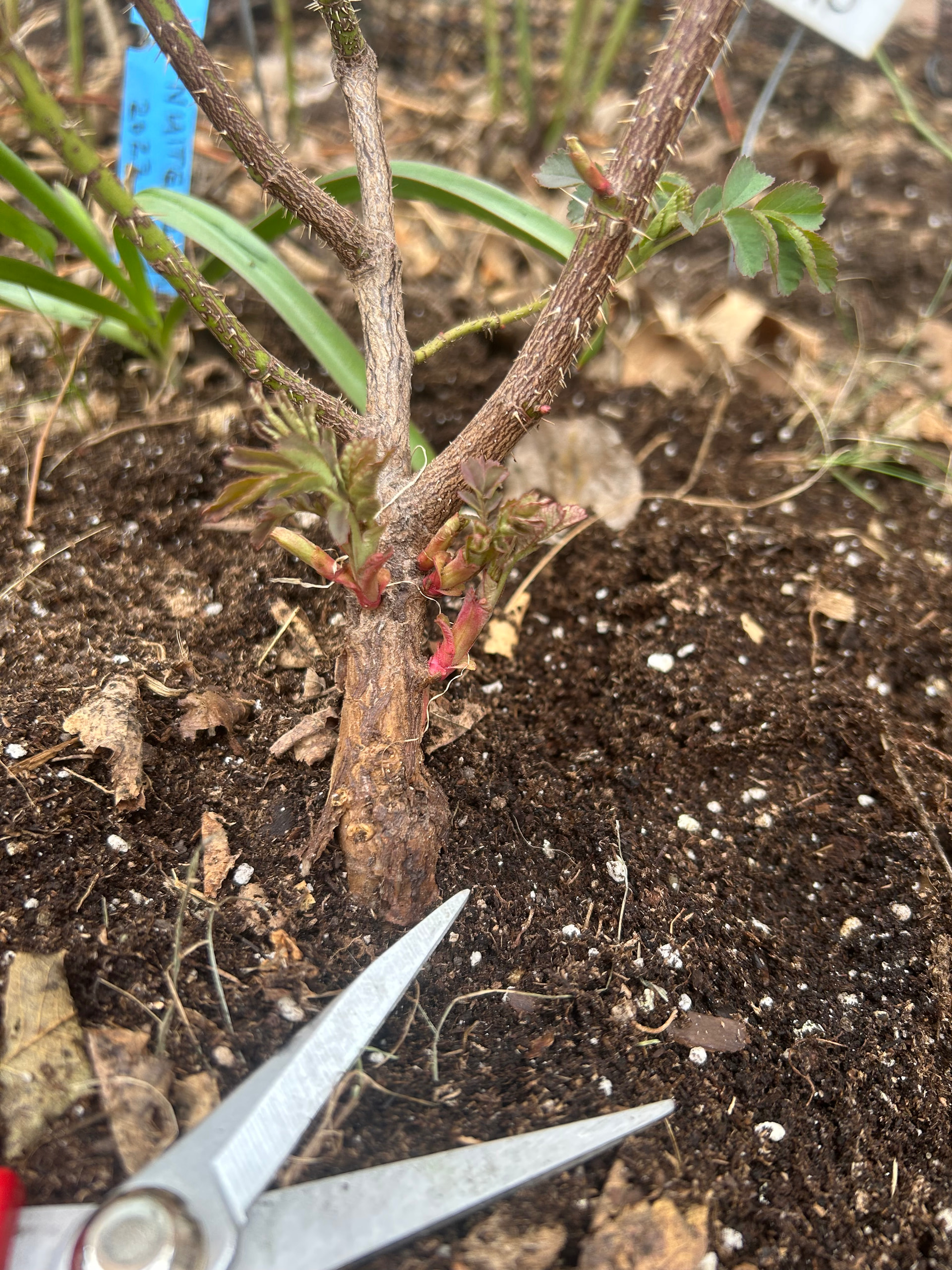
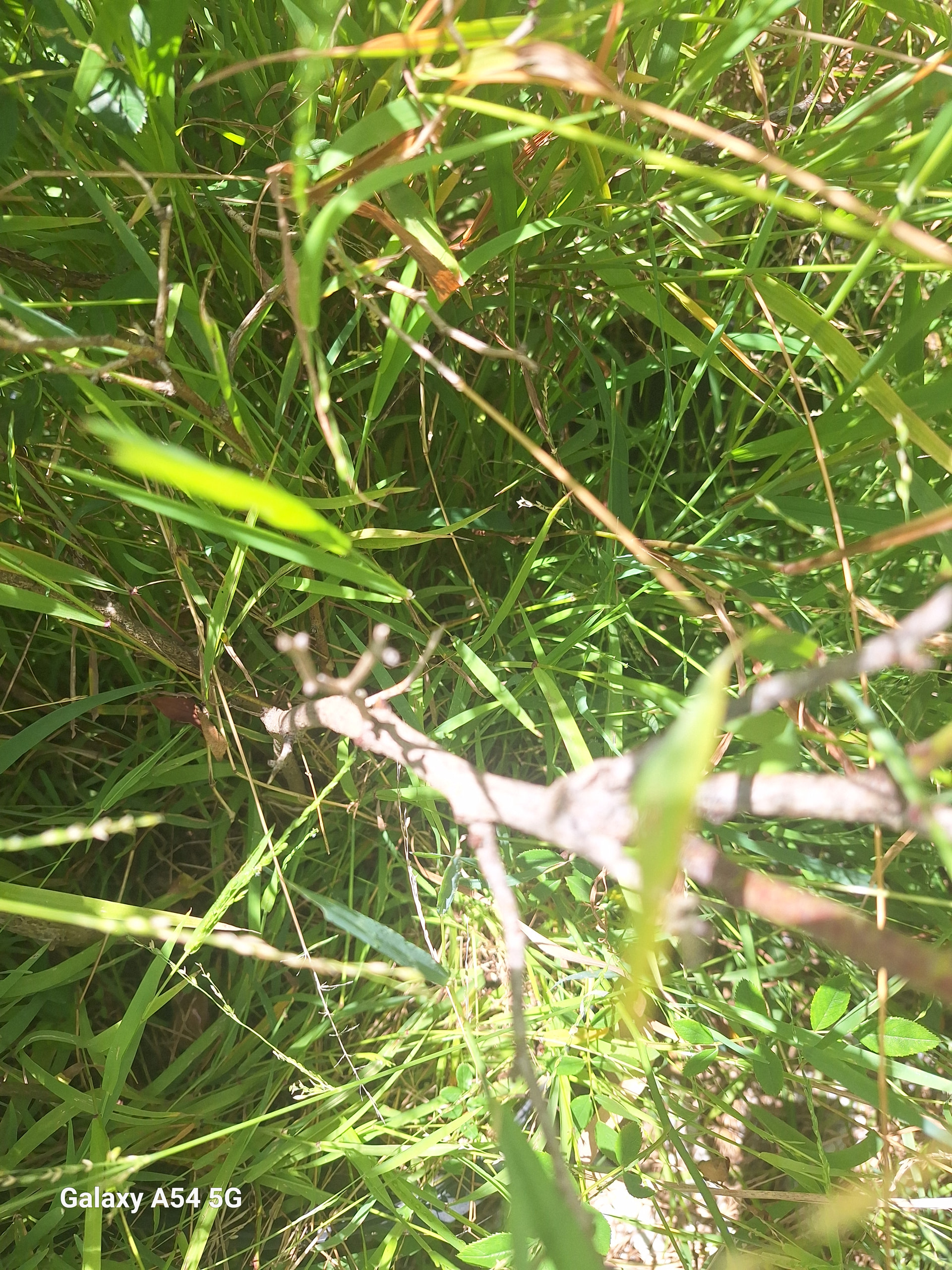
These occur at, or just above soil line from a, relatively speaking, sturdy thick crown primary cane - no others before this spring. Would have thought too young.

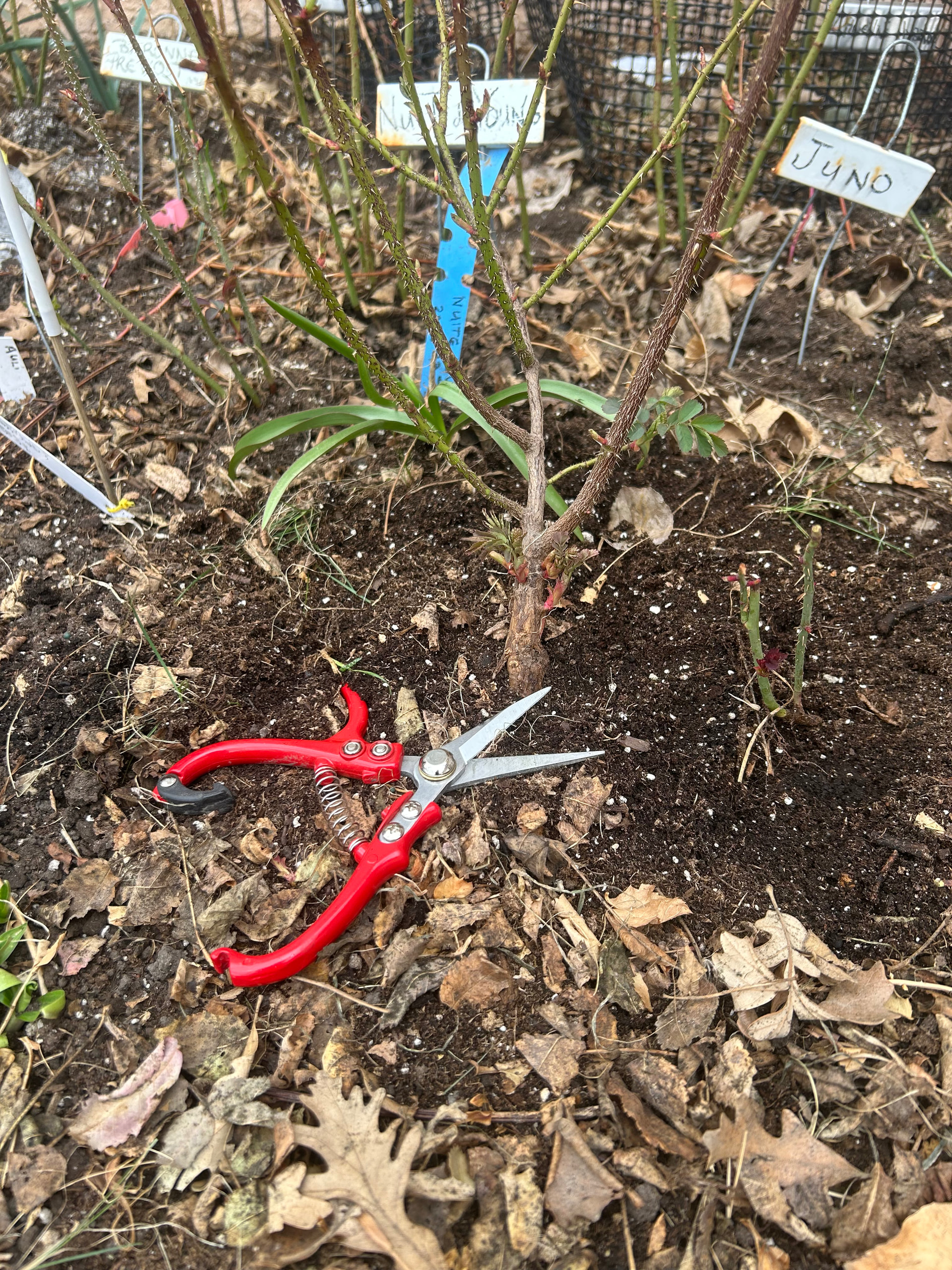
Photo shows 6 of the new cane breaks. One is behind expose cane. There are 7 in total. Soil kicked back 2- 3” for my clarity. I speculating since main canes slanted north most broke from south that gets full sun - acclimatized canes are “ burnt umber in color.

Has not bloomed. Better not be a blind shoot special. If it blooms yellow, know it was the post person. Hope it takes the pollen parent blooming characteristic and seed parent color and size.

Pollen parent can be late but goes for weeks blooming right up to mid fall - seed parent one bloom period. I believe pollen parent rumoured to have KSN-copia need check and spelling also.

Nope after neophyte genetic checking it has RoKSN - no copia insertion for continuous bloom? Requires china around to get a RoKSN- copia to give continuous bloom.

That which l read says requires an insertion by a china. Ah learned something, unless what l see, says this happened to my clone. Doubt that much luck. Well my prized seedling forced me to learn something close enough to be real genetic lingo and knowledge. Good rose promoting after the fact.

Sure is obvious from my episode why long periods for field trials. Anyways this rose is what makes species hybridizing interesting to me - first one l have done (beginners luck or hands of the Nordic gods?), using a strong titan rose with a tamed rose.

Thanks again.

PS

“Eva Helin”=

Merveille x R. Fedtschenkoniana

Seedling study name as it needs one from heritage
The other thing is that during Meiosis, the process where the male and female sex cells are produced, things can happen as the strings of chromosomes pull apart. It’s not always neat and perfect. Sometimes parts of one side of the chromosome chain can cross over to the other side resulting in something new. Plus when the female and male sex cells combine the expression of a gene can be very different from either parent or maybe just different from what was anticipated. Neat stuff.

2 Likes

Please explain more about out fertile triploids and “fun things”?

Fertile triploids don’t provide the expected half of the genetic material. It’s an uneven split because the triploid splits as 7 or 14 genes. Pairing that with a diploid can produce a diploid or another triploid. That has appeared to permit making combinations previously not easily possible. Case in point…I’ve attempted to cross R. Minutifolia with modern roses for MANY years. The few times seedlings resulted, they were weak and died their first season. Until I used Jim Sproul’s L56-1, which breeds like a fertile triploid. Several seedlings resulted and they are all documented on Help Me Find-Roses. I only used one for breeding as it impressed me as the most likely to produce what I sought. L56Min2 was lost this past winter, but several self seedlings raised from it demonstrate the species is “in there”. You can view the parents at these links. 'L56-1' Rose , 'Rosa minutifolia Engelmann' Rose and 'L56min2' Rose .

Here are some self seedlings out of L56Min2.

This is the more dwarf, runt seedling.

This is the seedling which suckers.

And, the most vigorous seedling.

All are thornless. All are pink, single, repeat-flowering. There is nothing behind L56-1 which should produce foliage like this, nor the bristles on the sepals, ovaries and peduncles. L56-1 is, I believe, a fertile triploid. R. Minutifolia is a diploid. Obviously, from the foliage and flowering parts, there is some Minutifolia “in there”.

I raised a seedling I call 'Puzzlement' Rose which strongly appears to have been R. Stellata mirifica X R. Fedtschenkoana. I put Puzzlement on L56-1 and raised some wild seedlings. The two I have retained are an ultra vigorous, pink single which is thornless and flowers continuously. 'L56Puzzle #1' Rose and one which flowers once, suckers profusely and is also single, pink. I can’t find photos of a flower but here are the wood and foliage.

I took my cue from this seedling Ralph Moore created. 'Golden Angelcalnana' Rose . Golden Angel is a fertile triploid. I’ve traced what I believe the source of that fertile triploidy back to Mary Wallace, through Brownell’s Golden Glow. Look what Mr. Moore created using the MINI, Golden Angel.

Golden Angel also figures in some of his striped mosses.

Kim Rupert is a fertile triploid. Crossing it with Lynnie (below) has produced thornless stripes and striped mosses.

Golden Angel also led to the fertile triploid 'Torch of Liberty' Rose which I crossed with the tetraploid 'Basye's Legacy' Rose to create the incredibly fertile, thornless, fertile triploid 'Lynnie' Rose . Legacy is once flowering. Lynnie never stops flowering.

Other breeders have created and used fertile triploids. Buck raised a number. One I particularly enjoy is 'April Moon' Rose . It worked nicely with 'MORcrest' Rose to create 'April Mooncrest' Rose which I crossed with Jim Sproul’s fertile triploid 'First Impression' Rose to create 'FIAPMC' Rose .

Take a look at a number of the roses used to create our disease resistant types now. Knock Outs are often fertile triploids. It’s a deep rabbit hole you can spend HOURS exploring. A Premium membership to Help Me Find-Roses allows you to use the Advanced Search where you can search for any criteria listed in the database, including ploidy levels. You can select the class and ploidy or just what ploidy you’re interested in.

2 Likes

Thank you the very detailed response. I enjoyed looking at all the roses you mentioned and my congratulations on having some of your roses released (I imagine you have had a lot of that all ready!). I had read about triploids quite a lot recently. I still haven’t worked out why they have knack of being more disease resistant… Less likely to occur so less adaptation from the diseases to the unlikely combinations is my layman’s theory. But yes I have definitely made some triploids this season, who knows if they will have fertility. I wonder why some triploids are more likely to have unreduced gametes produced than others?

Thank you. Good luck with yours! I can’t answer the gametes question, only that some of them do it. They are worth investigating as paths forward with lines which refuse progress. I have to wonder if some of Austin’s break throughs were due to triploids?

1 Like

That was a great write-up Kim. This year I’ve been using your Lynnie as my main fertile triploid for my species crosses and am already seeing some success with species pollen that stubbornly refused to set on anything last year. Those r. minutifolia crosses are fascinating and it’s interesting to see how different the foliage is compared to both of the parents. Have they proven to be more fertile than r. minutifolia? Do you have any goals that you’re working towards with them or are you just seeing what happens?

I try my hardest not to concern myself with ploidy because I am dumb and it might as well be magic to me, but I’m curious what the possibilities are for tetraploid pollen on a triploid. Is it anything from diploid to tetraploid offspring, with triploids being either 1/3 or 2/3s of either parent? I ask because after two years I finally got my hands on some r. arkansana pollen and immediately put it on Lynnie and Legacy (which I know is a pain).

Thank you. I actually have a Lynnie X Minutifolia seedling in back that I really should repot and take better care of. I’ve never pollinated ON Minutifolia. It tends to drop its hips early and they are small and VERY easily lost. Minutifolia pollen has sent on very few roses. Lynnie and L56-1 are the only two whose seedlings have been successful long term.I’d love to create a garden rose which resembles Minutifolia but is easy to grow in a regular garden. The 'L56Min2TT' Rose is a step in that direction.Mostly, though, it’s to see if it’s possible to accomplish something no one else appears to have attempted.

Tetra pollen works just fine on triploids. There are a number of Lynnie X tetra seedlings on HMF. It works the same as with diploids. In a diploid X triploid cross, you can have either diploid or triploid offspring. In a tetra-tri cross, theoretically you should have triploid and tetraploid offspring. Yes, it’s possible for the offspring to be a third or two thirds of the one parent. That’s what I hoped for with the Minutifolia crosses. Selfing them showed that’s how it appears to have worked. I’m doing the same now using Fairy Moss, Oso Easy Smoothie, Simon Robinson with Minutifolia and Stellata mirifica in hopes of moving the idea forward.

I asked Ralph Moore once if he paid much attention to the ploidy of the roses he used. He said while he found it “interesting”, he didn’t pay much attention because, “The rose finds the way”. I’ve actually sought out as many fertile triploids as I could easily obtain because I want to mine those weird traits which seem to be resistant to the usual matching ploidy crosses. I find it interesting that fertile triploids appear to breed fertile triploids. Good luck on your Arkansana crosses!

1 Like

Well I wouldn’t be surprised if big nurseries have used herbicides to double chromosome counts of diploid roses so that they are easier to hybridise with modern tetraploids. But I could be wrong… I mean as I’m in the UK these herbicides are no longer legal for general use so have considered trying to use nitrogen oxide in a pressurised chamber to do the same… Seems expensive and dangerous though. I wonder how much seedlings will differ from fertile triploids (used as bridge) compared to using a Tetraploid version of a diploid rose… do the tetraploids offer weird variations we can’t get with pure crosses.

Tetraploids offer generally heavier foliage with larger, more double flowers than diploids.

1 Like