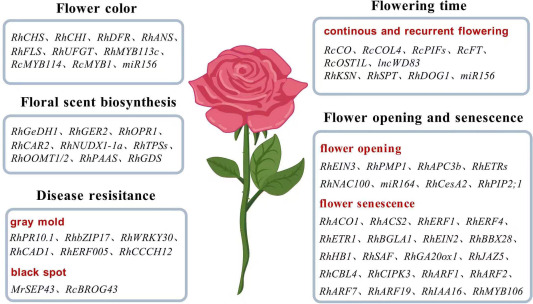
It has everything you need to get started using computational genetics to breed roses:
A once-through gives you a handle on where things stand now with computational genomics and genetics as it applies to roses.
Sections on color, scent, aging, flowering and disease resistance provide a panel of genes to work with.
A guide to the use of gene editing and machine learning for rose breeders
A list of online database resources where you can download the tools and gene sequences to get started.
You can bootstrap yourself using any of the entry-level AI tools as a tutor.
I’d recommend the regular Google Search box in AI mode to get started. It’s pretty good at vibe-coding scripts to download the gene data and will tell you how to set things up for machine learning. It will give you pretty decent tutoring on concepts if you ask, happily offering helpful suggestions if you get lost.
The freebie level Claude app seems to be more knowledgeable than Google Search but has daily limits so use it sparingly to flesh things out and quality check the Google output.
When you get to the point where you need more compute, Google Gemini has a free tier and both Gemini and Claude have hobby level paid tiers that you can step up to.
Even if you are only computational-curious, this paper a real eye-opener that shows how far things have advanced.
A particular citation in the paper was news to me and made me think of a useful project that’s doable on a high-end consumer PC.
I did not know that the genome of Rose persica has been sequenced end-to-end. R. persica is the source of the genes for yellow carotenoids from which Joseph Pernet-Ducher created the intensely yellow Soleil D’Or and is thus the source for all modern yellow roses. Unfortunately, it is also the source for the susceptibility of modern roses to Blackspot, Diplocarpon rosa.
The project would be to download the R. persica genome, suss out the genes for those carotenoids and design gRNA / Cas9 cassettes to splice them into, say, an Earthkind rose.
Blockquote R. persica is the source of the genes for yellow carotenoids from which Joseph Pernet-Ducher created the intensely yellow Soleil D’Or and is thus the source for all modern yellow roses.
Don,
Your contribution to this forum and the craft of rose hybridizing are substantial, and even after two years I am still very much a beginner here, so I really don’t want to overstep or let my outspoken hatred of LLMs cloud my judgement, but isn’t the source yellow pigments r. foetida persiana, not r. persica?
Moreover, it seems overly simplistic to talk about sussing out the gene for yellow pigmentation and using CRISPR to splice it into an Earth-Kind roses. That technology isn’t in any way accessible to the amateur rose hybridizer. I don’t really understand how chatgpt or claude or google can really contribute to rose hybridizing or provide us rose breeders any novel benefit when they don’t appear to even be capable of distinguishing between r. foetida and r. hulthemia. Much less democratize computational genetics and CRISPR cas9 technology.
I thought it would take a lot longer for someone to…spot…that
>I don’t really understand how chatgpt or claude or google can really contribute to rose hybridizing…Much less democratize computational genetics and CRISPR cas9 technology.
Someday very soon there’s going to be a kid somewhere who is going to ask their AI tutor what to do with their new Gilbert Molecular Erector Set…
>> That technology isn’t in any way accessible to the amateur rose hybridizer.
Genetic engineering pipelines have been industrialized. Retail markets already exist for much of them. You can order pretty much everything you need to crisprize a new plant ready made over the internet. The barriers are no longer technical or intellectual or even regulatory. The only significant impedance is money and that’s falling very fast.
As for LLMs knowing how to breed roses, ask Google search if it has already assimilated this very forum.
Just to make sure I’m interpreting this correctly, did you make that mistake on purpose to see how long it would to take someone to spot it? Or did you realize in retrospect that you made the mistake and then decided not to correct it, instead deciding to see how long it would take someone to spot it? I’m not really sure how to respond. Quite frankly, my first impression was that an LLM wrote the post and mistook r. foetida persiana with r. persica, but your response feels playful at best, and condescending at worst, and either way implies, to me, a level of intentionality that is at odds with the original post and you response to my comment.
Someday very soon there’s going to be a kid somewhere who is going to ask their AI tutor what to do with their new Gilbert Molecular Erector Set…
What?
Genetic engineering pipelines have been industrialized. Retail markets already exist for much of them. You can order pretty much everything you need to crisprize a new plant ready made over the internet.
Can you please direct me to a retail source for at-home CRISPR cas9 rose breeding technology?
As for LLMs knowing how to breed roses, ask Google search if it has already assimilated this very forum.