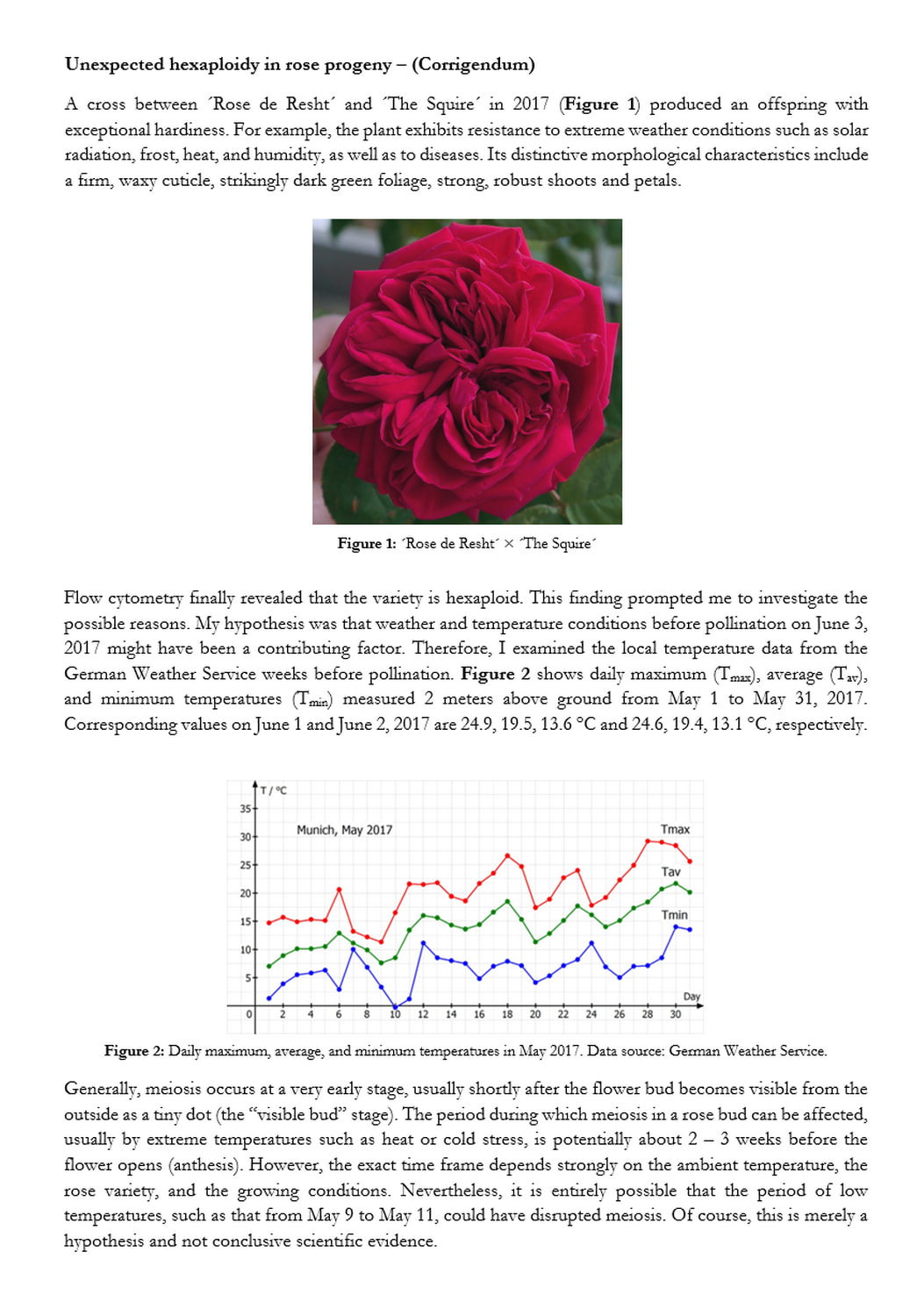
@MidAtlas: Thank you very much, Stefan! You pointed out an error on my part that resulted from misinterpretation of a statement. Meiosis does, of course, take place during bud development. That’s why I’ve now taken another look at the temperature curves prior to pollination. You’ll find the corrected text including new temperature curves attached.
@KDickinson: The analysis was conducted exclusively using flow cytometry. I am aware that this type of measurement, without additional traditional microscopic chromosome counts, is subject to a certain degree of uncertainty (see the article “Flow Cytometry,” Encyclopedia of Rose Science, Volume 1). Nevertheless, I am happy to have at least this. I do not have access to such a high-resolution microscope. Furthermore, I believe that the characteristics of my variety, which are typical of a hexaploid rose, could support this assumption. None of my other seedlings exhibit similar traits to this extent.
Thanks for linking this. I’d love to read the full study if it’s available. I’m curious if they just flow cytometry or if they also examined chromosomes under a microscope Recently it’s become apparent that there are some discrepancies between the two techniques, and it’s raised some questions about the true ploidy of Knock Out roses.
TAMU did a study a while back and found that diploids, triploids and (to a lesser extent) tetraploids frequently produced unreduced pollen grains. Sadly their paper is stuck behind a paywall so I don’t know whether they speculated as to why unreduced gametes happen or what, if any, factors promote it.
Well, the hypothesis as stated is fundamentally flawed, since meiosis occurs prior to the production of gametes, and that occurs prior to pollination and subsequent fertilization in roses. The graph shows that there was only a significant drop in temperature after pollination, so meiosis would have been entirely unaffected by temperature changes unless there were also temperature anomalies prior to June 3, 2017. Now, it could be that there was a delay in actual fertilization after pollination, and that the drop in temperature then favored fertilization by/of an unreduced gamete, but that unreduced gamete would need to have already existed by the stated pollination date.