Carefree Sunshine and Limoncello have yet to set hips for me. Are they triploids? If so, can I presume there is a decent chance of obtaining fertile offspring using enough of their pollen on a diploid?
If they are triploid, and I crossed on a proven fertile triploidmother, if said cross were to take, what are theoretical odds of di-, tri-, or tetraploid offspring respectively? I know for instance that Lemon Fizz is theoretically a fertile triploid, and I have gotten offspring using a tetraploid mate. Would that seedling most likely be a tetraploid from an unreduced gamete, or a triploid itself?
(I assume 4N x LF = probable tetraploid, but LF x 4N = just as likely triploid? Are my presumptions well grounded?)
Second Question: Vineyard Song’s two listed offspring use it as a pollen parent, but as a very double rose, anthers have largely been converted to petaloids. Is it not very seed fertile? (Only finding a couple pathetic anthers in each blossom after digging for a while.)
(I’m quite sure that was all poorly worded and not very comprehensible. I am way over my own head.)
Ah… So it is.
Interestingly Texas A&M group had, like me, speculated that it was triploid in 2023. The source for the tetraploid assertion isn’t stated, but for me it has been near sterile, which is surprising for a semi-double tetraploid.
I wish I knew the source of the tetraploid assertion.
One of HMFs listed offspring is mine: 103-08-01
I used Vineyard Song as a pollen parent simply because assigning Rosy Purple as the female parent made the process of pollination easier. Vineyard Song is very capable of working as a seed parent as well. It is almost certainly a diploid.
Thanks Paul. I decided to get V.S. over sister seedling Sweet Chariot based on some of your observations, and thought I remembered it was fertile both ways, but after scrounging for pollen, it seemed using as a seed plant would be easier.
I had not occurred to me that V.S. would likely be diploid.
Carefree Sunshine I think is tetraploid from chromosome counts I’ve made. It doesn’t set hips too easily for me in general, but this past summer when I crossed onto it, surprisingly a good number of hips formed. I think maybe as a tetraploid is is less self compatible than other tetraploids. I counted Lemon Fizz at 3x multiple times in years past, but some recent creative genetic analyses say it is tetraploid. There were two roses sold as LF over the years and during the transition I think Chamblee’s may have been selling the older one for awhile to get rid of stock and I assumed it was the Kordes one. I don’t know…. Anyways, maybe your LF that may not be too fertile may be 4x?
It seems that when using triploids as males, the 2x pollen is more competitive than the 1x pollen, so if you apply pollen more heavily, the 2x pollen preferentially gets through and offspring is more likely to be 4x. With lighter pollination, there is less competition and more of the 1x pollen gets through to participate in fertilization.
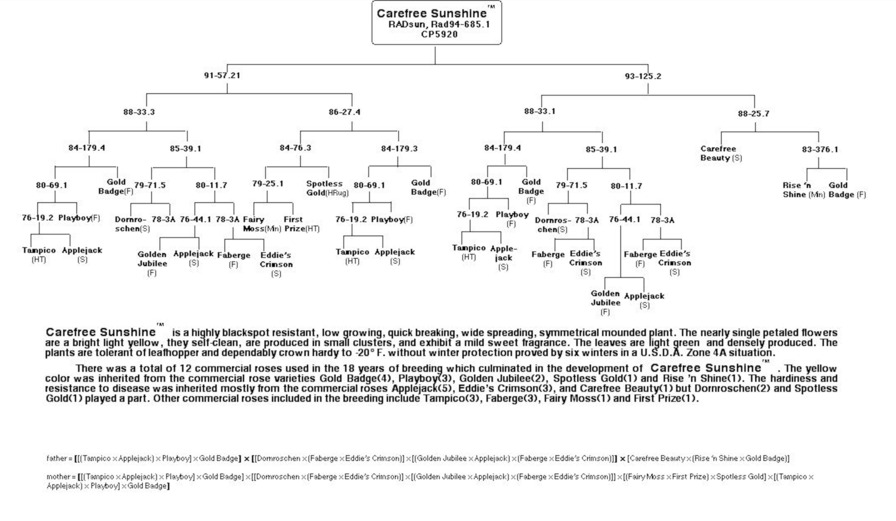
This doesn’t answer any of your questions, but since you’re talking about Carefree Sunshine I wanted to share this photo uploaded to HMF by Will Radler. I stumbled upon this when I first became interested in rose breeding and still find myself revisiting it because it truly is a celebration of the craft. The chart spans 18 years of crosses leading up to Carefree Sunshine’s creation.
It is also a relic from a time when breeding information was readily shared instead of shrouded in secrecy and intellectual property laws.
David, have you ever created offspring of LFizz with a diploid?
One of my hopes had been that I might get LF genes into some diploid lines. In my profound ignorance as to how these things work, I was assuming the split in pollen ploidies for pollen of a triploid papa would be roughly 50/50 (di- or mono- ploid), and the ability to pair would perhaps influence which type (ploidy) of gamete was more likely to win out to “father" a seedling.
I gather that ain’t so then… (I mean… if I don’t understand something, making stuff up is my next best option…)
Probably need to try and get a true monoploid yellow for my purposes then…
Is Larry Davis’ 13-1 available anywhere? I tried to grow seed from it but had no luck. And Crepuscule is still on my list, even if I have no space for her…
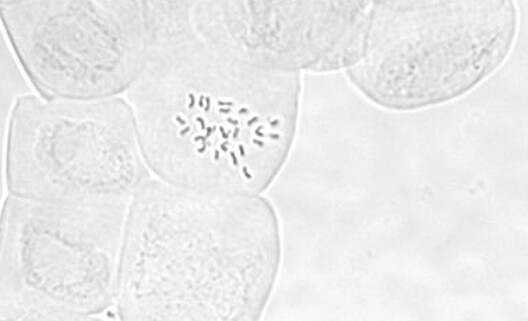
This is a group of cells of Carefree Sunshine with one cell at the right stage of cell division (metaphase) to stain and count the chromosomes well to see it is tetraploid. .
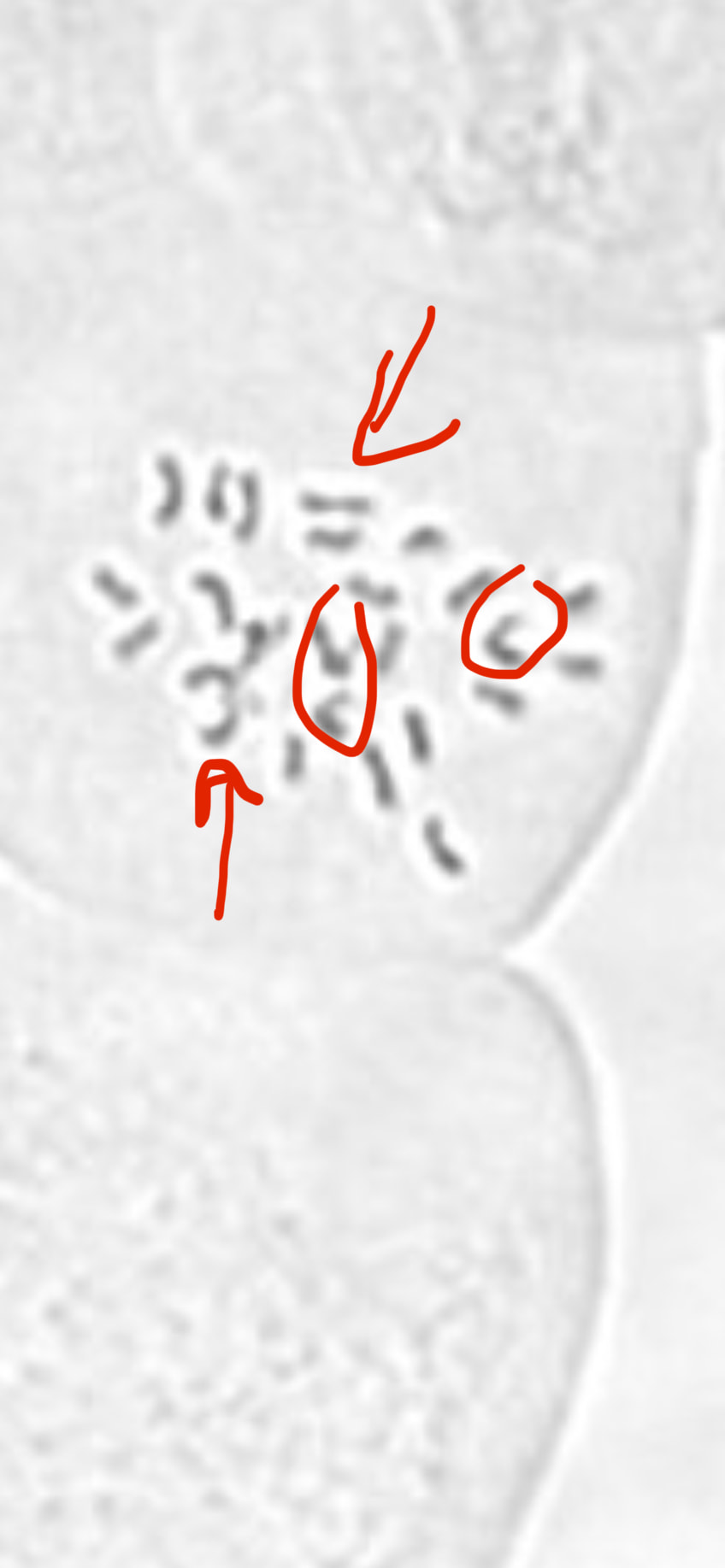
So I counted 25 dark blobs of various shapes, but about those shapes; the “v”’s and a “w”(?), are they chromosomes actively replicating, to separate shortly and make 2 from one? It’s strangely like looking at an X-ray of a belly of puppies and trying to count spines…
My post-HS science has too many questions. Would you be able to annotate the image, for the rest of the class, please? And do you see it all happen in real-time?! All my nerdy-senses are tingling.
One of the challenges is that we get a 2D image, but when at the microscope one can go up and down in focus and see some of the distinctions more clearly between different chromosomes. The chromosomes are duplicated, but the sister chromatids are still together before anaphase of mitosis. Carefree Sunshine (tetraploid) and Limoncello (triploid) were included in a SNP marker study to use a new tool to determine ploidy (Qploidy). If you go to the supplementary information at the bottom and the first table and second worksheet we can see all the roses tested with their ploidy and number of each of the 7 chromosomes. These two roses are included.
Remarkable image, David. Thanks. If I may ask, in what what sort of timespan does this all occur? I would imagine it a bit tricky to catch a cell at the perfect stage.
Good question Philip. The key is to just work with a very active root tip to have a lot of cells undergoing division (shoot tips are more difficult since there are chloroplasts and a lot more material that creates difficulty seeing the chromosomes). One needs to be patient looking through stained cells and hopefully come across some in late prophase or metaphase to see cells with countable chromosomes.