Blackspot resistance is as hit-or-miss in the Bracteatas as it is in any breeding line; it can be found, but one must be diligent in the pursuit of it. It is the overall character of the plant (plus the traits Simon listed) that makes it attractive as a breeder. I, for one, am particularly fed up with roses that have no vigor and require pampering and budding onto a foreign rootstock in order to make a halfway decent shrub. So, Brcteata hybrids have, for me, brought new strength and vigor into many of my hybrids.
Vigor is great but along with that often comes great size.
I am battling gigantism here. Working with derivatives of huge species roses comes at a price in terms of space requirements.
Working in genes for dwarfness and remontancy needs to be accomplished early on.
Since we’re talking about bracteata descendants, ‘Ebb Tide’ and the like, here’s a photo I took yesterday of,
Outta the Blue X (Riverbanks x Star Dust)
It’s a mini.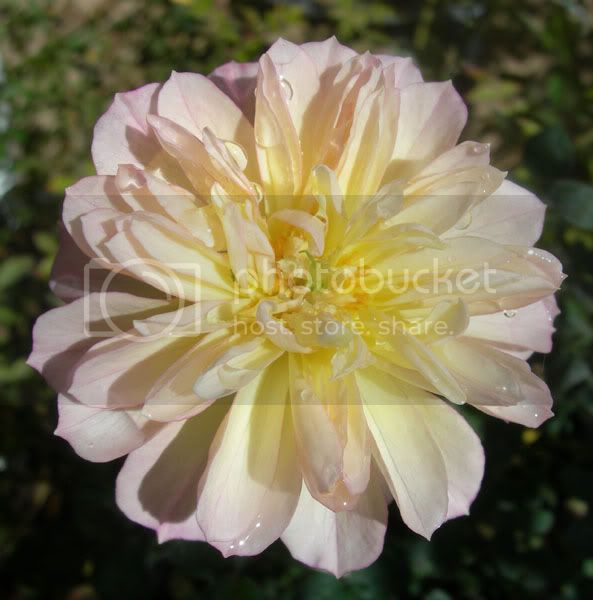
Hi Simon. You wrote:
Have we actually had a confirmation of 'Sweet Chariot’s ploidy?<<<<
This is a fundamental question, and definitley of great importance in my intended cross with ‘R.Bracteata’ if I want to guarantee diploid F1…
David Zlesak noted ‘Sweet Chariot’ to be a diploid in the ‘Red Cascade’ thread (about half way down page)… If this has not been confirmed however, I plead with readers to guide me to something mini that is a known diploid, and that can be found here…
Robert-N-R, the reason I chose a mini for this cross was to try and get the gigantism out of the F1…but who knows if this is what will happen? 
I suppose any ‘Sweet Chariot’ x ‘R. Bracteata’ F1 will take a couple of years to start to flower anyway…Remontatncy early in the new line is something I’ll tackle only after the F1 start to flower (and set seed, if they are fertile enough LOL). 
Hi Don.
The primary reason for developing a few ‘R. Bracteata’ lines was to get on with developing roses for our hot climate zones, here in Oz. Cold hardiness here is totally irrelevant, at least where the majority of the population lives.
By the way, I recently made a cutting of ‘R. Bracteata’ that had just started to callus after about 3 weeks under misting…It did develop blackspot in it’s stressed state, and so much blackspot, that I got rid of it, it looked pathetic… which proves to me that ‘R. Bracteata’ can get blackspot in my climate if it is stressed. So I don’t expect magical blackspot resistance to come out of this line.