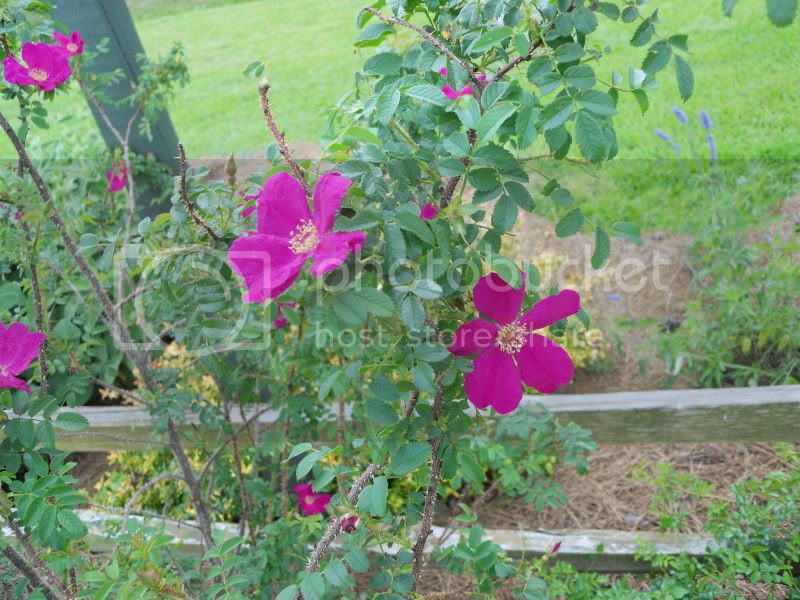
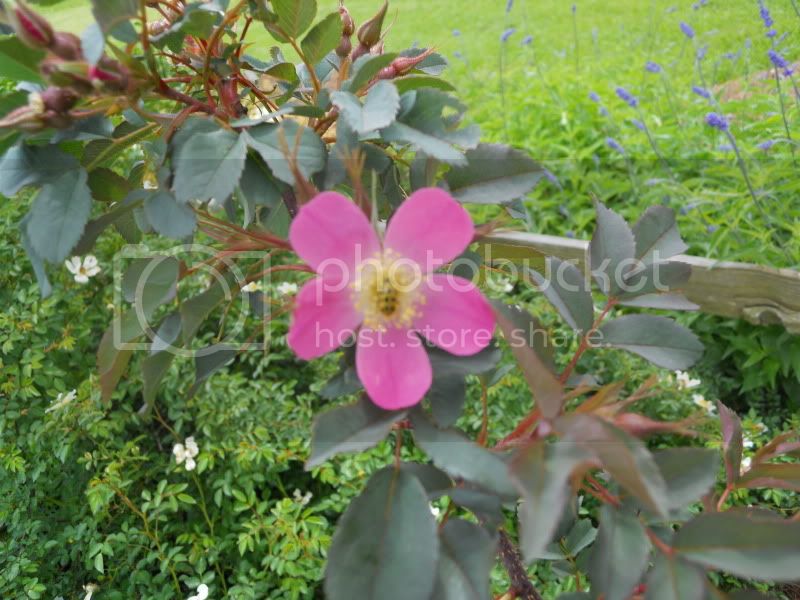
Thanks Kim. I went and checked and sure enough there is, even if its the slightest, scent on the new growth. I am very familiar with the Fedt. scent because I have a Corylus X R. Fedt. cross which has a scent which I believe is stronger than Fedt. and I just love to smell it every time I go past it. I am now trying to cross these two to try to get both the gray cast and the scent on the same plant with the flower color of this Corylus X Fedt cross. I just love that plant, it has not set any hips for me just like Fedt won’t but I put its pollen on about 6 different plants and they all seem to be setting so the pollen seems to be very fertile. I am having all kinds of fun this Spring.
That looks almost like Pink Mystery in the flower. How neat! Crossing the two would make a very interesting hybrid. They’d also be interesting to use with Paul’s cross of my Orangeade-Fedtschenkoana-Midnight Blue hybrid.
That plant scent is marvelous on a warm, moist morning! It carries farther, stronger than the awful flower scent (thankfully!). It’s been a lot of fun tracing both through further generations of crosses with modern roses. It’s quite interesting how Fedtschenkoana seems to be dominant for white flowers, and how much it dilutes genes which tend to saturate colors. Orangade, which makes very saturated plant pigments, washed out in the first generation to blush and white flowers. Other crosses with
Dottie Louise brought blush to light red. Crossing those with 1-72-1 and Cherry Parfait resulted in peach, scarlet, medium red, “old lady mauvy red/pink” and red/yellow bicolor. The scents have ranged from Damask to very spicy, with flower forms from single, through quartered and fully double open forms. So far, all of them have some sort of scent to the growth tips and flowering parts, too. Kim
I looked up Pink Mystery and you are right it does look like it. The color is a little off, I find it is more of a red/purple than pink. Well maybe deep pink/red/purple, there that should cover it. I have hips forming on midnight blue from Corylus/fedt. That I can’t wait for. Hopefully I can get enough seeds so some will germinate.
Patrick, that is a cross I MUST test for heat resistance, black spot and rust resistance for you…PLEASE? I hit a client’s garden this morning to collect some Midnight Blue pollen for use on some of the Fed. seedlings tomorrow. Kim
I always thought that white flowers with R.glauca foliage would look good. Last year I did a similar cross to your R.glauca x R.fedtschenkoana, but I used a (John Davis OP) OP as the pollen parent. JD OP OP has small white single flowers and very blue foliage, so I am hoping for the same effect that you got. JD OP OPs foliage doesn
Now, we need someone to gather all of these blue foliaged crosses together and work with the widely different ones to produce breeders combining the various species into a few new ones. Who’s up for it? Kim
Wow Kim, that would take a while, I think I’m too old. But I do have another one that I am trying to figure out if it is a hytbrid or not. The color is exactly like Frontenac which is the pollen parent(I hope) and this one is very vigorous, more so than Glauca. So here’s another to throw in the mix. And it sure does bloom a lot. I have about 60 hips with home run pollen on it. Had about 50% take.
That’s lovely Patrick! Imagine, though, what could be accomplished with several people using the same hybrids with the same goal… It would also be lovely to get these things put up on HMF with “blue foliage” listed prominently in their descriptions so it would be searchable. The names shouldn’t be the cross such as abc X def, but more like abcdef so it doesn’t interfere with the search engine. More of these things need spreading around so they aren’t lost and can amount to more than one person can accomplish with them. Kim
I’m young enough but I dont wanna. Other than space limitations, we all tend to follow a path that satisfies our curiousity, desires, goals, etc. Now, if I had a crap load of land then that would be a whole new tune. I’d absolutely love to randomly plant one of each species out and about on the countryside. I’d probably just be told that I have to move them because they threaten native ecosystems or some such thing =/
There’s a magnificent glauca at Elizabeth Park but I have been wary of starting another raw species project because they take up so much space and because canina are such wild cards. I’d be willing to work with close hybrids, though. That foliage would be a valuable trait to capture.
Thanks, Warren. So, what kind of restrictions are there on sending rose seeds there? You just need some various seeds from these neat things and some dirt…Kim
We can get both glauca and fedtschenkoana here. In terms of seed, so long as they aren’t species seed of a species not on the allowable imports list we can bring them in in small quantities as Rosa hybrida or the species that are allowed.
A friend of mine has fedtschenkoana and he’s sending me cuttings so I can try my luck with it too. I want to put it with dupontii or clinophylla (seeing as ‘Muriel’ turned out tetraploid I was figuring clinophylla might show some surprises like this too). I have 'Orangeade’cuttings arriving soon too. It would be interesting to try these kinds of species with some of the other warm climate species like gigantea, bracteata, clinophylla and some of the species that seem to grow well in heat and cold like rubiginosa.
So many people here are disinterested in trying new species. I’ve been trying to give away plants of longicuspis var sinowilsonii and had only one taker over the last four years.
I HAD Sinowilsonii and would love it again! My Clino-Bract seedling is covered with the oddest looking buds. I’ll post some tonight. The whole plant is chlorotic but growing like a fire. Kim
My clino-bract are yet to flower but are growing strongly now. The straight clino seedlings are about to start flowering a month before winter sets in. If that pattern continues pollination is going to be a pain in the bum.
On the up side… I have about 300 sinowilsonii hybrid seeds in the fridge right now as we speak… it was a most receptive and cooperative Mum. Bit worried about the seed though. The hips were beginning to turn orange so I picked them but the seeds were still green; hard but green. I hope they had matured enough to work. Always next season if not
Patrick, you are pursuing a route I have long wanted to pursue, and I am envious as well as excited at your results. A half-dozen years ago, well pre-Katrina, I had shuffled some pots and Reine des Violettes ended up next to R. fedtshenkoana where she bloomed. I loved the look of her bloom over R.f.'s foliage and have wanted to pursue that sort of combination ever since. I’ve probably posted about it numerous times here.
Glauca x fedtshenkoana was on my list, as well as some rugusas crossed with R.g. and with R.f… Corylus gave you something nicer than I would have anticipated. And the Glauca x Frontenac is also very nice.
Thanks Philip, These are still very young, second year and both Fedt.hybirds seem to be seed sterile but pollen fertile so I have a lot of pollinations done. We will see what kind of foilage we get at the F2 generation point. O Love all three of them
As a fellow Louisianan, I’m glad to see them looking so healthy and happy too. I wasn’t sure how glauca hybrids would fare in the deep south, and was actually wondering about going all the way back to a china in a first attempt. (Some of the deeper red chinas have a little blue in their foliage to offer, and I figured it would be a test without having to fight too many ploidy issues resulting in something tolerant of heat and humidity.)
Good to know I shouldn’t have to do quite that level of ‘proofing’ on my own.