A few months ago I came across a paper in which the authors claimed to have crossed the wild-type sweet pea (Lathyrus odorata) with ‘Painted Lady’, the first color variant to be introduced so long, long ago.
They were wrong.
I wrote to one of the authors to explain that I had 19th century reports from three men who made the cross and got very different results. One of these men was Charles Darwin. My polite note was not well received. I was assured that “the science” was not in error.
The simple fact is that the sweet pea strain being distributed as ‘Cupani’ is an imposter. If you want the genuine article you can get seeds from Dr. Keith Hammett of Auckland, NZ, or visit Sicily to collect your own.
Similarly, the original ‘Painted Lady’ was long-since replaced by a more stable look-alike. Breeding experiments dating to the early 1900s suggest it was already gone by then.
Now there’s this:
Theor. Appl. Genet (2001) 102: 398-404
The domestication process of the Modern Rose: genetic structure and allelic composition of the rose complex
M. Martin, F. Piola, D. Chessel, M. Jay, P. Heizmann
p. 402
(2) “Common China” (no. 58) and “Bengale Animé des Anglais” (no. 54) belong to the group of the “Chinenses”. Their present non-discrimination confirms the failure of Raymond (1999) to distinguish these two cultivars using 30 morphological, three colorimetric, 16 chemical (flavonoids) and three isoenzymatic characters.
This all sounds as obscure and scientific as anything can be, but I object.
On page 399 of the paper, ‘Bengale Animé des Anglais’ is said to have been created in 1832. This is certainly not Knight’s ‘Animating’, which was introduced to France from England prior to 1817. The alternative is ‘Rose Animated’, raised by Hibbert and Buist of Philadelphia, PA, and introduced prior to 1832.
If the various modern authors could not distinguish this variety from ‘Old Blush’, they must not have smelled or seen either.
“No. 2. *Rose Animated, daily, is a very fine rose, and its merits are appreciated by those who have it in their collections. It is more double, and better formed than No. 1 [Rosa indica, common China or daily], and partakes of the fragrance of No. 8 [Rosa odorata], is perfectly hardy, colour a fine blush, grows freely, and flowers abundantly; and is coming into great repute.
*Those marked thus * we have grown from seed.”
Furthermore, C. M. Hovey (June 1835) wrote, “The animated Daily is a very desirable rose, as it retains its form for many days, closing up every night, a peculiarity quite uncommon.”
Buist’s ‘Animated’ was (is?) literally animated, smelled better than ‘Old Blush’ and lasted longer.
Last time I visited, there was a rose at the San Jose Heritage Rose Garden identified as, ‘Bengale Animée’.
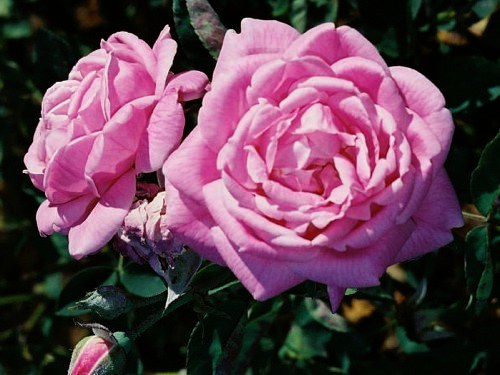
I don’t know that this is Buist’s rose, and I never hung around after dark so see whether it closed. And last time I saw it, I didn’t know that I should be sniffing it.