This is an old photo I took of ‘Austrian Yellow’ pollen. It doesn’t look very promising as a parent. Thought it might be of interest.
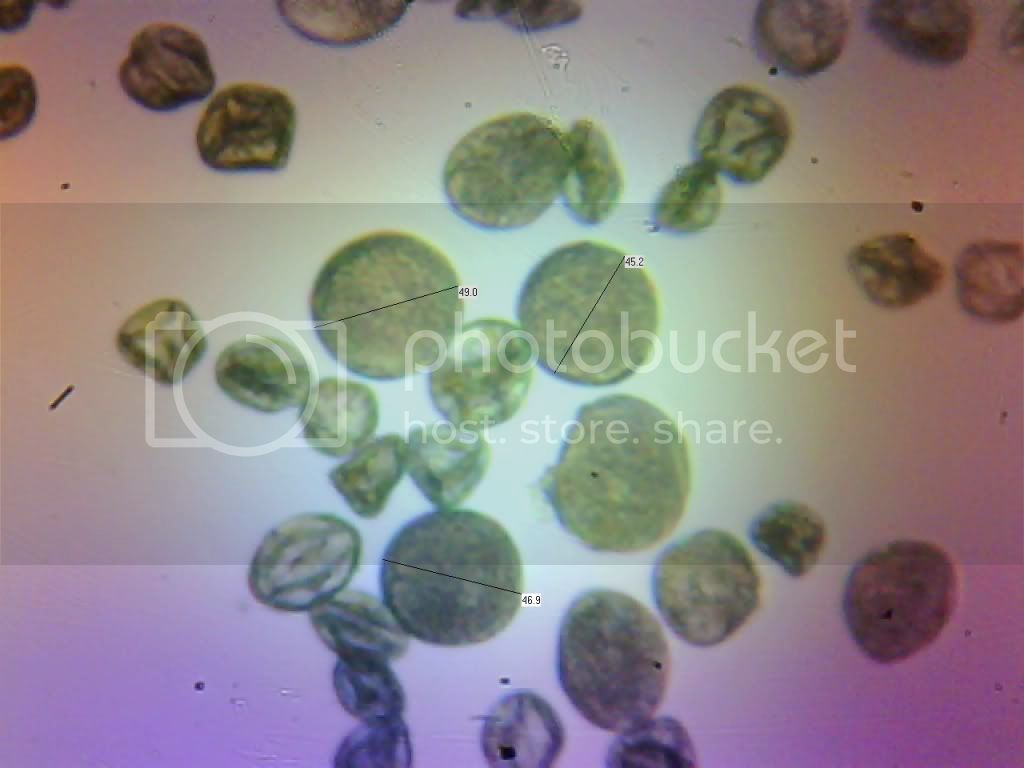
This is an old photo I took of ‘Austrian Yellow’ pollen. It doesn’t look very promising as a parent. Thought it might be of interest.
You’re right there aren’t very many viable grains, but the ones that you did measure are huge. According to Davids paper on pollen diameter those are in the octoploid range. Whether or not the plant is really an octoploid is anyones guess. I measured some grains this summer from one of my seedlings which was a cross of a tetraploid x a triploid. I assumed the plant was either a triploid or a tetraploid and I was measuring the grain to verify which. But the grain sizes were much larger than I expected they in the octoploid range as well. I used it as a seed parent and as a pollen parent this year, in fact I’ve planted some of the seeds and have one seedling so far.
Frequently a mixture of the very large cells with small ones means it’s triploid. There are not many octoploids.
That’s interesting, but it makes more sense than the plant being an octoploid. I measured several different pollens this summer that had grains in both the diploid and tetraploid ranges. Those I figured were triploids
Another option may be that it is a tetraploid rose and the only gametes that are balanced enough to survive are those that are 2n gametes (n stands for the gametophytic stage and 2n the sporophytic stage, therefore pollen that is 2n is pollen that has the same chromosome count as the parent that produced it). During the process of meiosis parallel spindles or some other mechanism keep together complete sets of chromosomes and those that do not do this are aneuploid (incomplete sets) and abort. Even though the rose may be tetraploid, if it has a diverse genetic background and the sets don’t recognize and pair accordingly, normal n gametes (in this case they would be 2x if it is a tetraploid parent) are hard to come by. This is just a thought.
I think your option makes good sense David, it explains the large size of the grains. My plant was a Morden Centennial OP x Fuschia Mediland cross, so it was a fairly wide cross and the chromozomes probably didn’t pair up well. I had to cull it this year becasue it got leaf spot so bad, but I did cross it with several plants (one being a daughter of 1T20) that were very clean so I hope the seedlings fair better.
Great photo Margit!
The nice thing about roses with lower fertility due to issues like these is that, oftentimes, if you apply enough pollen and do enough crosses, you can still come up with viable seedlings.
Jim Sproul