Dee, I think this is the photo you want. This is Henry’s “Rugelda x R15” seedling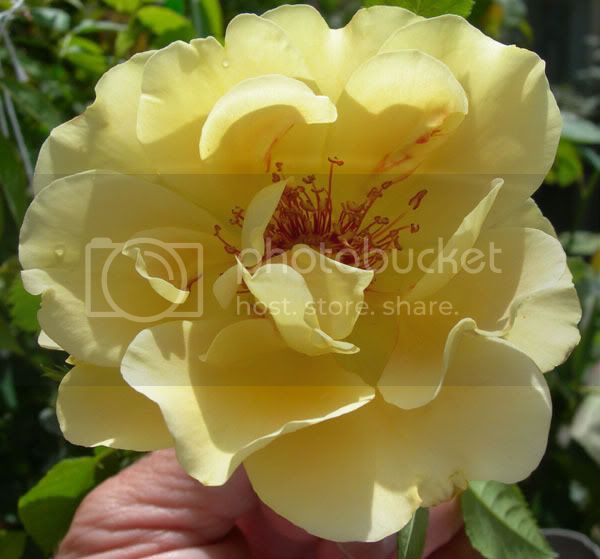
again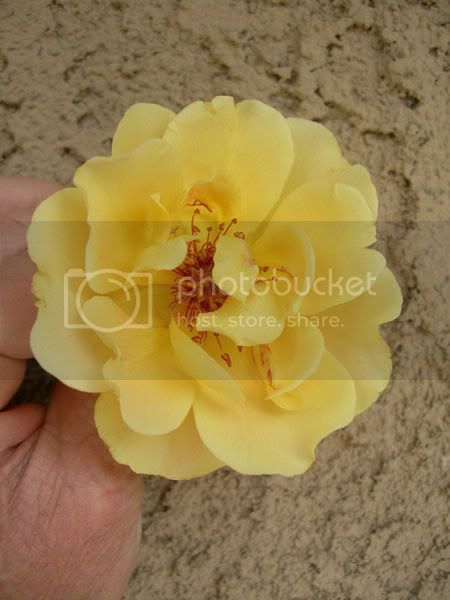
Dee, you have a great memory. Henry, that is a very nice looking bloom. Robert, thanks for posting it.
Liz
Dee, I’ve had this rose now for four years, three of those wintering in a rather exposed garden patch where I’ve observerd it as being stem hardy down to -32c, after that then blackening and dying to the snow line. I have now moved to another location and since have kept it potted for breeding purposes, though it’s not terribly happy under such conditions. As for my location, I live near Edmonton, Alberta, where temps can reach a mind numbing -40c, though of recent years not dipping nearly so darn cold nor lasting as long, thankfully!
The weather here has changed also, Terry. At one time there were 10 foot snow banks starting in early October with temps that made it down to -32C. Now days we get all our snow after a January thaw, and mild temperatures above -17C. For the first time in history last year we experienced a green Christmas in the snow belt of Ontario. Rugelda is supposedly not hardy in this area, but looking at how the temperatures have changed, there might be a chance to grow it.
Robert, thanks for posting that wonderful rose! Those red centers reminisce of Peak Frean cookies, lol! I can’t think of many roses having red centers like that, though; Canadian White Star and Dainty Bess come to mind.
Can anyone say if Rugelda will pass red filaments to its offspring? What are the chances of getting seedlings with red stamens if Rugelda is used as a parent? From where are these centers coming from?
And is the above Rugelda x R-15 a fertile parent?
Dee, I also love red stamens!
Rugelda x R15 was new for me last season. Mine was a very young budded plant produced the Fall previous so I didn’t get too many blossoms. It’s much larger now so I hope to have more opportunities to utilize it (and share photos) this Spring. I did use it as pollen parent last year and got hips with some but not all seed parents.
So far I’ve not had any germinations from seed produced.I believe Henry has had better luck.
It’s distressing to hear about your weather changes. I’ll be interested to hear other weather changes you have noted. I’m sure you know the USDA has already rezoned parts of North America.
Paul,
I have been mulling over your message and thinking about your very valid concerns. The responses have been excellent I think and hopefully, the suggestions incorporated into the solution. Here goes some of my thoughts.
I think the answer lies in THINKING SMALL instead of thinking big; big rose nurseries, big rose societies, big universities are too much involved with their own agendas these days and making money. There has been a long long history of this; think of Griffith Buck and his rose programs. Shortly after he retired the rose field was plowed up; luckily, someone,probably the family, thought to save some of the mother plants as well as unreleased seedlings which are just being introduced now, thanks to his wife and daughter and Roses Unlimited. Now, after many years and with a rise in the popularity of his roses, the University I believe has planted a garden to him and his creations. This is but one example of several I could mention. As was mentioned, think of what Radler has accomplished following his own muse. Albert Norman in England worked as a diamond cutter and only introduced about 10 roses but they were the stars of their day and I think he did it all on his own property: Ena Harkness, Vera Dalton, Frensham, etc. Charles Mallerin was an engineer and hybridized part time on his small property and think of Ami Quinard, Blanche Mallerin, Mrs. Pierre S. Dupont, to name a few. Dee Bennett started hybridizing in her mature years and I don’t believe she had a science background; most of the big hybridizers discouraged her; luckily Ralph Moore, took her under his wing and even gave her foundation stock. Tiny Petals nursery operated out of her front and back yard. The front yard had benches where all her rose plants for sale in pots were displayed and the back yard had a small green house and place for growing roses. She sold roses all over the USA and had lots of winners. All these are examples of one individual following a dream and working hard. Look what they accomplished without the backing of a university, national society, or a big rose company. So, an individual can make all the difference. Think one person here, one person there; the internet can join them all together as we can see. Why not start a web site or blog for just this purpose.
After small comes EDUCATION; again a central website could have links for innumerable topics on breeding roses; I have seen many wonderful websites and when I think of all I have learned on Garden Web with its many contributors, both amateur and professional, newbie, and experienced veteran, sites such as Paul Barden’s, Karl King’s, Malcolm Manner’s, etc. In comparison what I learned from the ARS and my local rose society is minuscule. As pointed out in one of the responses, you have to educate people that there ARE people out there creating new roses.
You have described often the need for introducing species to get better disease resistance and hardiess. Get the information out and make cuttings or suckers of the species roses available to eager amateurs. Hybridizing is costly but most people are happy to spend some money on their hobbies; this is where the HOBBY amateur hybridizer has it over the professional; he or she can do it on the cheap, they can use simple, less technical methods, and they don’t have to worry as much about making money off their rose since their livelihood doesn’t depend on it. I am a retired librarian and was an avid library user from childhood. I trained originally as a teacher; I knew teachers trained at colleges. Librarians were people sitting behind a desk; though I lived in the library that is all I knew; it wasn’t a gender issue since our librarian was a male. It was only after I had taught in the classroom that a high school classmate whom I had know since elementry school badgered and badgered me to go to library school which she was doing. It wasn’t until my second meeting that I decided to enroll. Couldn’t have been happier. My point was, back then, there was no information out on how to be a librarian or what the profession entailed. Maybe the stork brought them. As was pointed out, one has to point out the need for hybridizing roses and show what is involved and what might be accomplished. People have to be made aware that there ARE people out there creating new roses with desired characteristcs in their back yards.
DISSEMINATION OR DISTRIBUTION. There was a thread on Garden Web several years ago about roses no longer being available and in fact extinct. One of the wisest and most generous ladies, Rosanna from Texas, said that in her opinion, the way to assure the existence of a rose was to distribute the cultivar as widely and as much as possible. We can’t rely on the Botanic Gardens to keep these roses available; financial restraints, a change in management at the top, natural disasters can all occur and wipe out the one “safe” cultivar available. I think here the small nurseries can be of help rather than the large ones. The big ones seem to want to carry the sure thing; I think it is the smaller specialized nurseries who are willing to take a chance on the amateur hybridizers’ creations. Several of the speciality nurseries seem to be doing it already in the USA. It took a decade for KNOCKOUT to catch on but it finally happened; and now “little” Knockouts are appearing and selling like hot cakes.
Agree with Henry also, Northern roses would be better than Canadian roses; it is more inclusive. We all know the Explorers are of Canadian origin and we thank the Canadians for their effort and are grateful to them. I was thinking today of Gene Boerner and his hundreds of floribunda creations over the years and the thought came into my mind, should we have called them American roses and I started to laugh. No, no, no. David Austin started calling his roses English roses and received much criticism certainly from rose enthusiasts if not his collegues. It was a put down for all the other English hybridizers. Cooperation is better fostered by inclusiveness amongst all the cold regions of the world; working together to solve similar problems. Other cold regions germ plasm will be used after all. The names can pertain to Canada. I have learned and relearned so much Canadian history just from the names of the Explorer roses.
So, Paul, enough of my long windedness; I think putting your article in print will make people more aware of the problem and needs of the future and maybe, starting with a small nucleus of a handful of people, things can get started. I agree, with the special need for cold hardiness and the general need for disease resistance in Canada, Canadians are ideally situated to start the ball rolling. By the way, it was pointed out that people want smaller growing plants. Here, input from the rose nurseries, who deal more with the public, would be helpful. Have noticed and read that in the USA, in many areas, people want larger houses and smaller lots!
Wish you the best of luck in this; I think if the word gets out and people are shown how, and some mentoring is provided, one will start to see results in a few years, possibly quicker, than going the usual established route. Terry has shown us some beauties. We have the “young uns” down here getting started as was pointed out. Max is still in HS I believe; you have them there too, you just don’t know it yet! Think of the pioneers!
Best wishes,
Jim Provenzano
PS-Hopefully I have not offended anyone; this came from the head and the heart. Unfortunately I have too many years under my belt now, to be a part of what could be a very exciting movement.
\
1 Like
This is so very interesting from the standpoint of a small “renegade” retailer that has been in the business for over 25 years now. First big and what sells is not necessarily the answer, especially over time. Yes, compact may be the trend now but by the time current hybridizers can bring out a rose the trends may have swung in the opposite direction(and then we have a lot of throw away roses and wasted effort.) What seems to be the recipe for truly classic roses is the passion and vision imparted in a knowledgeable and inspired cross.
Yes, I think the species should be reconsidered. And, don’t we have so many very amazing antique roses to work with which have weathered all the fads? Although not in any way a hybridizer, I have a hunch that our gene pool is becoming just too complicated.
Why do some of the best roses vanish from cultivation? Case in point: N.E.Hansen’s 'Lillian Gibson.'I know, because some person in a position to say “nay” sees “once blooming” and drops the rose from production not knowing what a truly superior rose this is.
So all you impassioned rose breeders out there just go about what you love to do best. Make sure your best roses get into the hands of true rosarians, you’ll probably never get rich breeding roses and the people that truly appreciate roses will treat you and your creations with integrity.
And as an addendum, I have a fairly extensive collection of hardy species and rugosas and am always wiling to share cuttings.
Suzy V,
Thanks for generous offer.
Do you have any seeds/hips of R spin. Altaica?
Seems that Altaica was in your catalog at one time.
It is difficult to find, and much used in northern hybridizing.
dave
Dave, You can get an unlimited amount of Altai rose seed from me. Keep in mind though it takes a minimum of two years to germinate. If you want pollen let me know.
Paul
I have been playing around with ‘hardy’ roses for a while now and have found them to be what really interests me. My first goal and what still is my primary goal is to breed cold hard climbers that are not red, pink or white.
After setting my goal, I needed to start searching for parents that I felt would advance towards meeting that goal. I was required to be a collector. There are some fantastic cold hardy roses out there, very few of them (with the exception of the Canadian Explorers etc) are easy to find. I have made been able to get some nice roses. Beauty of Leafland and J5 are 2 of my more prized hardy roses. Williams Double Yellow and Apple Jack were not hard to find but I consider important. These 4 roses will get heavy use this summer. I did manage to finally get a small plant of R15 which will need a couple of years to mature.
I like big roses, love em actually. Anything that eventually shows any promise from my efforts will be big. For me that is the future of northern roses. Others will see a different future. You breed for what you like. Could care less if other people like what I have created.
If I were to have a secondary goal that some might consider as interesting for northern roses, it would be to improve upon what Griffith Buck started. He created some really nice roses but many of them have problems that need work. A lot fade or blow quickly. Some get PM badly (Folksinger for example). Some dont drop thier petals and leave a brown mess in place of a flower (Hawkeye Belle). Some are not all that disease resistant. Many are not really that hardy and can be lost in a (USA)Zone 4 winter. There is quite a bit of room for improvement. I think they would get fair acceptance. Roses similar to Buck roses with a little better performance. Not through the big companies though. You see very few Buck roses being offered through the big places. There are lots of them out there though. The leader of the local rose society is planting a whole garden dedicated to them. There are a lage number of small garden centers in the midwest that sell them. There is a wonderful rose comminuty out there. If a rose truly shines, there will be many people willing to give it a chance. With the internet connecting growers and societies, word of mouth can spread.
John Sheldon is an example of word of mouth. I would never even thought about buying his roses. Then I met him online and he even came by to look at the rose mess I called a garden. Since then, the only roses that I buy that are not hardy are his roses. Numerous people from the on-line communities go on a spring John Sheldon rose search, digging through piles of nice roses looking for that one Hollywood Star that has evaded them for years. I think something similar could happen with other smaller scale rose growers. Especially for someone who came up with a great rose that can take the strong prairie winds temperatures down to -30. -27 in Iowa this winter. My parents are my test growers. Even colder in Minnesota where my brother, one of my other test growers, lives. If you draw a line starting in Eastern Idaho down through Wyoming, across through south central Nebraska, central Iowa, northern Illinois, nothern edge of Indiania,Ohio, Pennsylvania New York and finally through central Vermont and New Hampshire. People north of that line are the target. Thats a big area. They all could use a nice hard rose that doesnt blow and holds its color.
I’m really enjoying this thread, lots of great ideas and comments about what is happening and what needs to happen in the future.
Koren in Saskatoon
It’s taken me awhile to get back to this thread, but I wanted to respond to Jim’s comment that “an individual can make all the difference.” Yes, of course, and I always keep that in mind. Still, in Canada and other countries we have to keep in mind people having an interest in rose breeding will likely continue to decline. A major factor for this situation is that children for a couple of generations have mainly grown up in cities. They have generally not grown up having parents who had a vegetable garden and sometimes fruit trees/small fruits. Therefore, they don’t have an opportunity to develop an interest in horticulture.
I think of my childhood on the Canadian Prairies and in North Dakota, where I lived in small villages and the economy was based on agriculture. My parents always had a vegetable gar- den and the family preserved wild fruits (maiinly saskatoons) for winter eating. I can remember one time we collected rose hips that were made into jam. I was also closely connected to the natural world, because I only had to walk a few blocks and I was out on the Prairies or in the Parkland ecosystem where it was adventure unlimited. These experiences also gives one an appreciation for horticulture, in my case when I was in my late teens.
Traditionally, advances in Canadian rose breeding come from the Prairies. Even the Explorer Rosa kordesii hybrids couldn’t have been developed without Robert Simonet’s (of Edmonton, Alberta) ‘Red Dawn’ x ‘Suzanne’. The reason for this, of course, is the cold climate (Zone 2 - 3) restricts the growing of rose cultivars commonly grown in warmer climates. Therefore, be- cause rosarians and gardeners wanted to grow higher quality roses on the Prairies than just Rugosas or Spinosissimas, breeders were challenged and had to be ingenious in their programs to develop such roses.
The future development of Canadian roses as far as new types, if there will be any, then will likely come from the Prairies. The chances of this happening, as I’ve previously explained, are declining. However, we can only hope it will. I know for one thing, I’ll be re-doubling my efforts to develop interesting species or near species hybrids that may have a future use in Canadian or other cold climate (Zone 2 - 3) rose breeding programs.
Thanks to all for your responses.
\
Paul,
A small city garden can be enough for someone to develop an interest in gardening. My parents had a small garden and they were never enthusiastic gardeners. However, both me and my brother have now taken up rose hybridizing as a hobby. All it takes is to have a garden that one has to fill.
Of course, we may be the exception that confirms the rule 
Rob
Growing up in the cities may be partially to blame, but another major reason is that the parents of the younger generation are just too busy to have gardens. Demands on their time are enormous. Both parents have to work to pay the bills, the kids are shuffled from day care to home, and in some cases, there isn’t enough disposable income to afford a garden.
Decisions must be made, and often the importance of a garden (and many other important life experiences) are less than they should be. The children don’t get exposed to gardening like the previous generations. What the children do get exposed to tend to be electronic in nature (computers, game boys, television, etc.)
Above anything else, I would have to agree with Andy. For teachers who have summers off, those with horticultural degrees, and those awarded scholarships to fund this type of research & experimentation or those who have careers with Agriculture Canada, life may be a peach! Others who love the art of hybridization may find it difficult to make time to partake in this pleasure when life demands that two incomes be earned to make ends meet. And if they reside in the country with land to sustain a no-fuss-garden to suit their working lifestyles, where do they find time to indulge in hybridization when they must work 40 hours a week to sustain their livelihood? Hybridization may briefly take place when holidays are scheduled around the time when the roses are in bloom, but even then, a limited number of crosses are accomplished for whatever little time is left of their vacation. Easier said for those who are retired, but for most people who face at least another 25 years of work before retirement, it’s not as rosey as one may think.
I have given up on tetraploid roses and work exclusively with diploids. I have gone on were Dr, Svejda left off. With here rugosas. I am breeding for near 100% hardyness above the snowline, red stemmed and smother leaves- rather like a Therese Bugnet plant. The flowers I want to be like a grandiflora. In this after 8 years I have come close. Sorry that the photos are out of focus- the camera was new. Be sure to look at the other photo to see it next to Martin Frobisher.
Link: groups.msn.com/Johanneshybrids/roses.msnw?action=ShowPhoto&PhotoID=2
Hi John,
Great looking flowers. It does look like you’re getting real close. Is this plant 100% hardy for you? Do you have any other plants that you have photos of?
One my goals is very similar to yours, that is to bread what I call “Improved Therese Bugnet” roses. I’m breeding for red smooth stems, 100% hardy, great disease resistance, near continuous bloom and a nice fall color. Therese Bugnet is close, but it needs better disease resistance and better repeat bloom. I hadn’t given much thought to flower style yet though, grandaflora style would be awsome. I’m just getting starting so I haven’t gotten very far along yet.
Paul
My issue with Therese Bugnet and its kin is that theyre too tall for modern gardens. But there is more room up north, so that is understandable when you factor in the harsher climate hampering growth, too.
However, the thing I love about some of the newer rugosas in the more compact growth that gives rise to better branching habit w/ a stronger bloom impact. Jens Munk, Rugosa Magnifica and Fru Dagmar Hastrup is super nice here.
Turbo is interesting. It is cluster-flowered and has multiflora in it via Pink Grootendorst. It’s too big, though. HMF says it is 3-5’, but it was massive at Heirlooms when they used to have one. It’d be perfect if it was shorter, more fragrant and lighter in its pink.
Anyone know the ploidy of Therese Bugnet?