Good sap flow is usually when the heat arrives and the plant is vigorously growing. It’s the sap flow upward toward the growth tips that push growth and that’s what’s required to permit you to successfully lift the bark to insert the scion and to keep the scions nourished and moist until the cambium layers between the two parts knit together into one piece of tissue. If the plants appear to be growing inches a day, they’re likely getting ready to be budded. Cardinal Hume is easier than Huey but not AS easy as Pink Clouds, IXL, De la Grifferaie and the other multiflora types as these all have thicker cambium layers than any non multiflora varieties. They remain in suitable condition for budding much longer during the season than any other types and don’t have to be in as frenzied a growth rate to succeed. The images above should succeed if planted as I showed in the earlier photos using cylinders of soil to keep them cool, dark and damp until you see them pushing new growth. Then they can be gradually uncovered to allow them to acclimate themselves to the hotter, drier, brighter conditions.
Hello, I am interested in getting some rootstock. I am located in Northern California on the coast. I would interested in getting a few different ones to try out.
Welcome, TJay! One of the easiest stocks to work with at home is Ralph Moore’s Pink Clouds. It is a cross between the found miniature, Oakington Ruby and R. multiflora. The multiflora provides it a thicker cambium layer, the “stem cells” of the rose which callus to form roots as well as knit buds and stocks together. It roots VERY easily and the thicker cambium allows it to remain in condition for budding over a significantly longer period than Fortuniana, Huey, Gloire des Rosomanes (Ragged Robin), Laxa, Canina, etc. It isn’t AS “Arctic hardy” as pure multiflora or Canina nor AS resistant to high alkalinity as Huey but for areas where those extremes aren’t the norm, it’s a wonderful stock to use. It’s also very long-lived. Sequoia Nursery used it for decades to produce every mini standard they generated as well as all of the full sized standards they sold through the nursery. This is one of the poly Sunshine, I purchased from them more than 20 years ago for a gardening client I had at the time. I planted it in a large pot on her patio where it grew for many years until she tired of it.
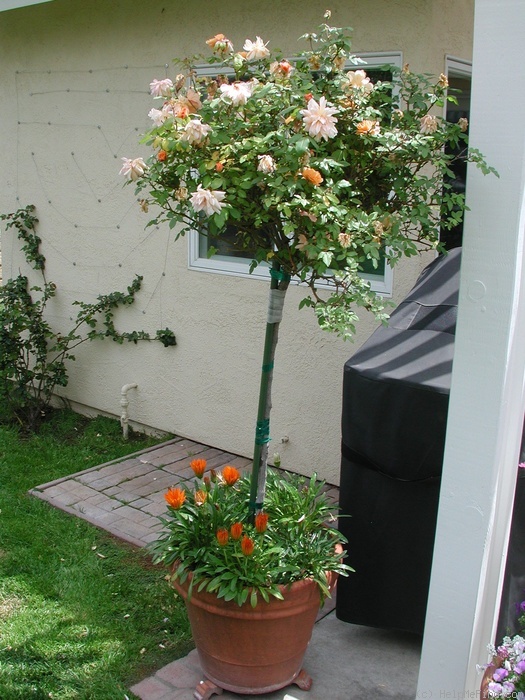
I removed it and took it home where I planted it in the yard where it grew for a number of years until we retired and moved north. I then gave it to a friend in Santa Barbara where it still grows. This is that same Sunshine standard, on Pink Clouds, in her Santa Barbara garden. She reported the head is approximately 5’ in diameter.
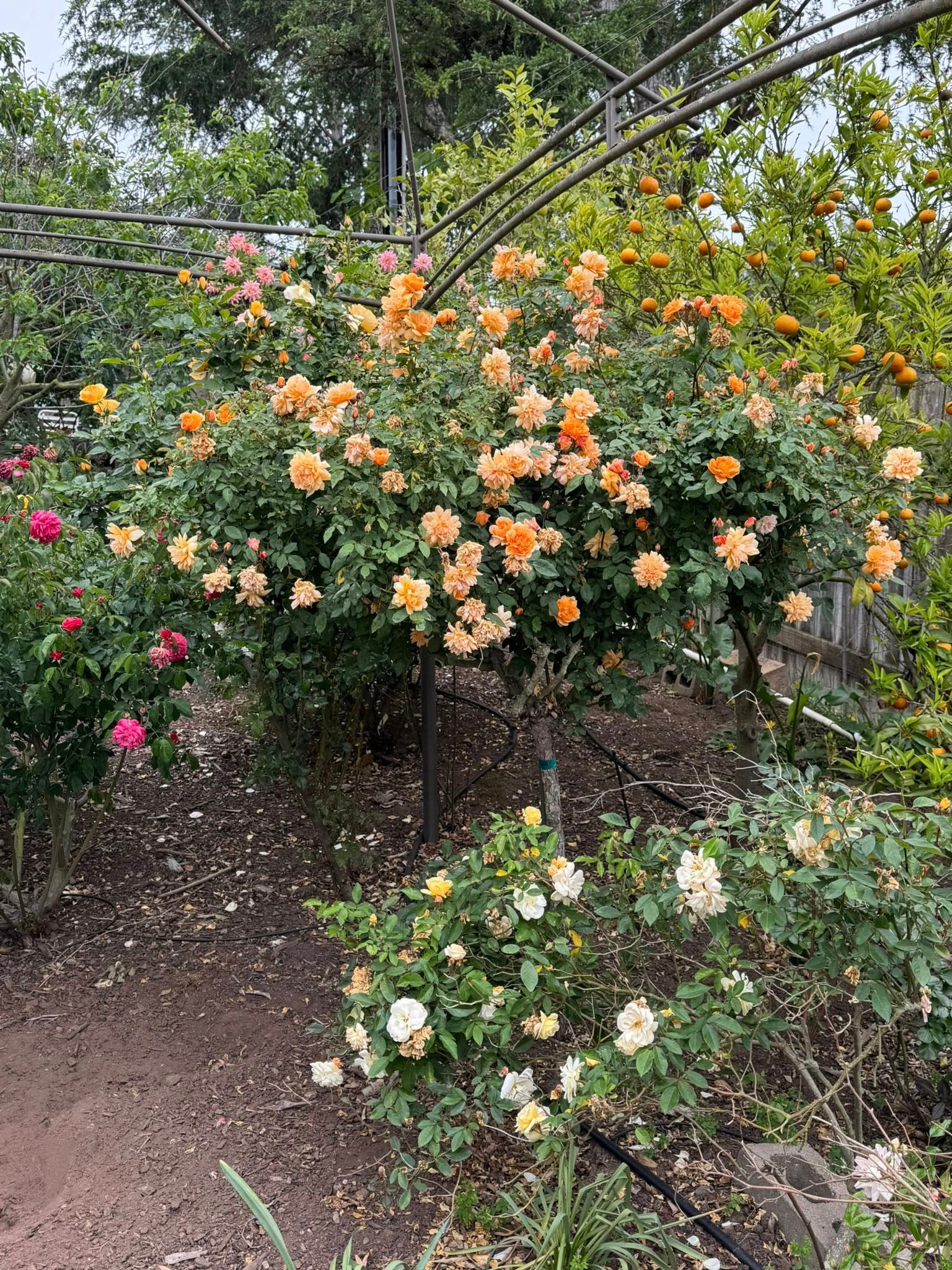
I had Pink Clouds indexed and it was found to be free of the strains of plant viruses for which they test, so it’s “indexed, virus free”. Sequoia maintained it for over half a century as a mother stock and it remains that as long as the mother plant isn’t budded or grafted on.
Pretty much any type of rose can be budded or grafted to it as long as the bud isn’t wider than the width of the rooted piece you’ve selected for the stock. Its thicker cambium makes using either T buds or chip budding significantly easier than Huey and others where the thinner cambium is much more easily cut through, exposing the pith. For a bud to succeed, there needs to be cambium to cambium contact between the back of the scion (bud) and the stock. Burling Leong, Burlington Roses, produced all of the budded plants Sequoia Nursery sold for several decades and she promoted the use of Pink Clouds and chip budding in her rose society programs for years now. Her pdf illustrating how to do it is on line. There are many tutorials on YouTube as well as many blogs, including my own. Pushing the Rose Envelope: Chip Budding There are many other posts concerning budding on my blog so feel free to browse as your interest dictates. I’ve also shown how to root and bud longer whips of Pink Clouds on it for standards.
If you’re proficient at rooting cuttings, I can send you cuttings of Pink Clouds for the cost of postage. If you’d prefer starting with a rooted plant to grow as your mother plant for stocks, High Country Roses sells it and has it in stock. Pink Clouds so you can plant it and begin rooting cuttings for stocks as it grows. Just allow it to mature until the gauge of the canes grow to the thickness you wish and root them.
If you want to “collect them all”, UC Davis Foundation Plant Services produces them and sells cuttings. Their requirements are to be found on their site. Foundation Plant Services
When I lived in the hotter inland areas around Los Angeles, I had great success using Pink Clouds, Dr. Huey, Fortuniana, IXL, De la Grifferaie and indexed Cardinal Hume. There was enough heat for them to callus, push roots then push growth from the scions. Now, living in a chillier, damper climate along the coast in northern Santa Barbara County, I have abandoned Huey and Fortuniana as we don’t have enough heat to push them to continue rooting nor to push growth from scions. The multiflora types don’t require the higher heat the other types do, so I sent the Huey and Fortuniana to others and have only retained those which work here in the “coolth”. If your area of San Jose is more cool, coastal, you might find similar issues. If your location is hotter, more “inland” conditions, the others may work well for you. I hope it helps!
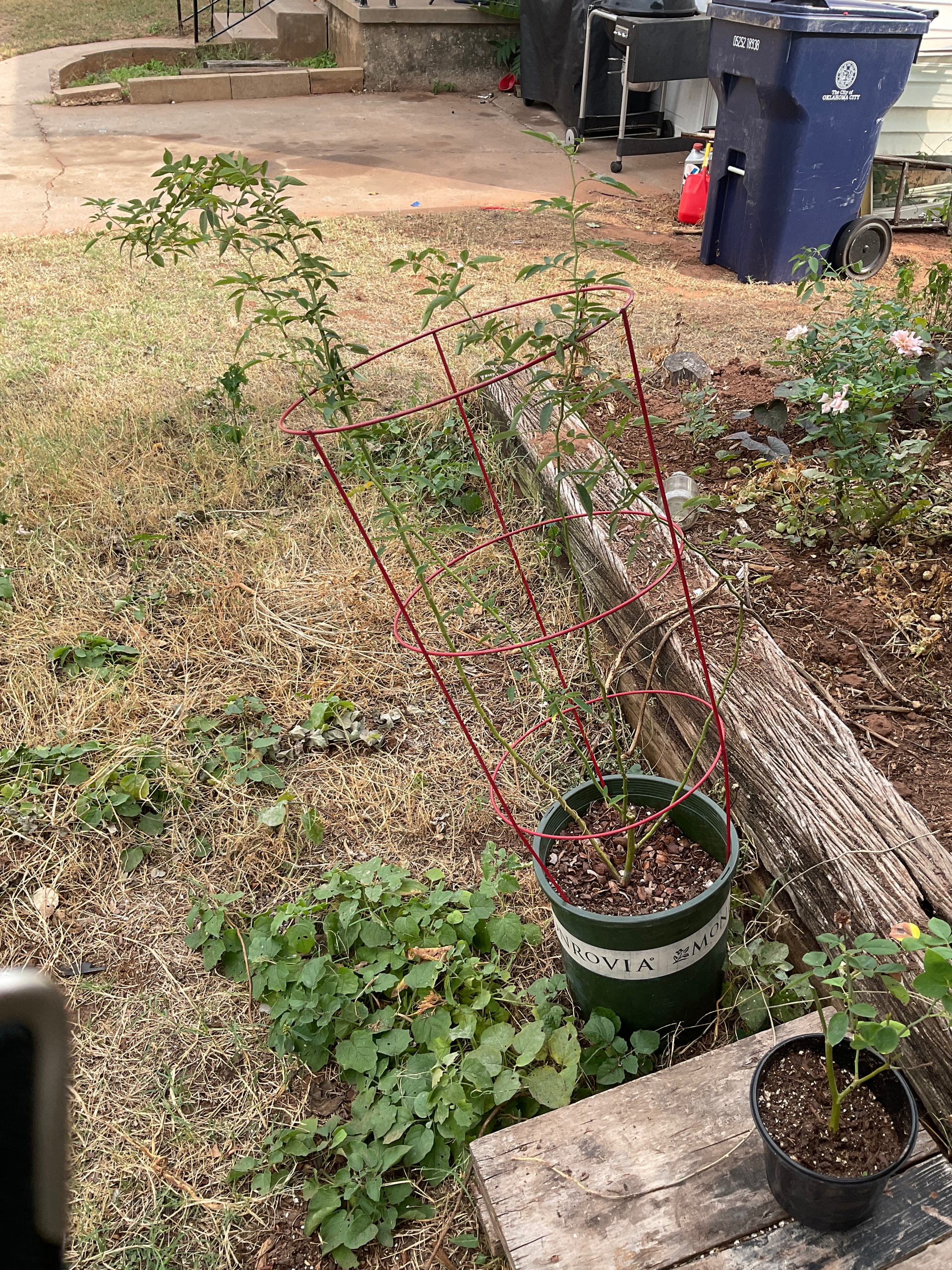
Welcome! I can attest that Pink Clouds has by far been the easiest rootstock for me to root and graft with. Not the best photo, but in less than a year one of my cuttings had thrown out several 3-4 foot long whips despite being root bound in a 5 gallon pot.
Hello,
Thank you!! This is very helpful information. I think I will probably get a pink cloud plant to try out.
I imagine I will have more questions.
T
Can folks speak to the relative merits of different stocks for different climates and soil types? I am wondering for instance if there are better understocks for drought tolerance of moderately alkaline soils such as we have in south and central Texas.
Doc Phooey is the usual, of course, as most roses sold here come from the big growers in Tyler, TX.
(It intrigues me that there aren’t a wider range of stocks used situationally for roses as there are for e.g. fruit trees.)
The big players in the industry are motivated to make things as simple as possible for their process, and that means they most often choose Dr. Phooey to work with, because 1) it’s easy for growers to physically work with and to grow a finished product on, and 2) it grows well in most any climate and soil type. The fact that it’s horrible for consumers in the long run (suckers, anyone?) isn’t important to the growers.
Makes sense I suppose, but I wonder, couldn’t exhibitors manipulate results by the selection of proprietary root stocks? When submitting new introductions for trialing are there standards for leveling the field to obtain more objective results?
I am a little bit surprised more investment hasn’t been made in improved (virus-free) stocks. (Would their be a market for such?)
SoCal exhibitionists frequently graft to Fortuniana to produce oversized flowers. Foundation Plant Services at UC Davis is the source of virus indexed plant materials of all kinds.
They list 9 different named stocks. Dr. Malcolm Manners suggested offering them Ralph Moore’s Pink Clouds but, sadly, nothing came of that before Malcolm retired from Florida Southern College where he ran many horticultural and agricultural programs and planted several rose gardens. It was he who spread the indexed rose materials they cleaned to various nursery sources around the country for many, many years.
Yes, there are indexed “virus free” stocks available, but they do cost. Arena Roses actually grew mother blocks of indexed multiflora, Huey and Fortuniana in Wasco and budded to them for different areas of the country. That was one of Syl’s many experiments which cost and didn’t pay for themselves. I’m sure there are other producers who have made use of the Davis stocks. I collected indexed Fortuniana, IXL, Gloire des Rosomanes, De la Grifferaie, Dr Huey, Pink Clouds, and had Cardinal Hume and Nessie, as well as a few of my other seedlings, indexed. I found Cardinal Hume to make a wonderful standard stock and a friend used Nessie as a stock to bud the Viraraghavan roses he was trialing in the Palm Springs area.
I found Fortuniana and Huey to demand significantly greater heat to callus, push roots and push scions than my coastal climate can provide so I passed them on to a friend in Santa Barbara where there is that heat. They were wonderful back in the inland valley heat of the Los Angeles area. The multiflora types perform well here as they require MUCH less heat to root and push scions. I’ve retained IXL, De la Grifferaie, Pink Clouds, Nessie, Cardinal Hume (I imported it from Harkness forty-plus years ago and love it) and Gloire des Rosomanes (which I’ve never tried as a stock, I just love the rose for itself. It’s found in many abandoned gardens, likely both as overgrown stocks as well as for itself.).
So, yes, there has been work done to produce indexed stocks and they are available.
Yeah I actually haven’t even used GdR as a stock. I found myself so enamored with it that I wound up using all of my cutting for ornamental purposes or as seed parents.
Lately I have been thinking about rootstock breeding though. Not so much in a “reinventing the wheel” sort of way, but more as a natural byproduct of following Ralph Moore’s approach of breeding for a healthy plant to then “hang” a pretty flower on later.
Last year Kim you mentioned how both Basye’s Legacy and 0-47-19 would both have potential as rootstocks were they not virused. Seeing how willing and vigorously they set roots it got me thinking about “marrying” those genetics, because even if the progeny lose the qualities that would make for good rootstocks they’d likely still have use in a breeding program. I try to not put too much focus on ploidy, but my plan is to cross the tetraploids and diploids together first, so the tentative idea is:
[Gloire des Rosomanes x Basye’s Legacy] x [0-47-19 x Pink Clouds]
Like I said it’s really more of a byproduct since this part of my broader goal (also inspired by your writings, Kim) of a breeding stock which combines wichurana, multiflora, OGR, and Legacy genetics. I’ve read that Pink Clouds is prone to powdery mildew, but it’s the only rose of mine which has confirmed multiflora genes and PM is a non-issue in my garden anyways. I’ll also be crossing 0-47-19 with Peggy Martin this year so that might replace PC in this plan depending on the results.
I hope to opportunistically work r. arkansana genetics into these crosses just to see if its crazy 10 foot deep rooting tendency shows up with without too much extra baggage. I’m (perhaps naively) hoping that the likely foliage issues downstream of arkansana crosses are less of a concern when only looking for value as a rootstock.
We’ll see what happens in a few years.
Ironically, here in the “mildew zone”, Pink Clouds is spotless. Even water stressed, it’s clean. We’re nine, flat miles from the Pacific with a fairly constant wind. The sun is brilliant and hot with daily temps in the low to mid seventies currently. Nights drop into the low forties with HEAVY marine influence…heavy dews and a good amount of fog on occasion. The ground is WET in the mornings and even without rain or irrigating the “lawn”, the weeds germinate and grow vigorously. If something is going to mildew, it will, here. This is Pink Clouds a few minutes ago. The bit of white you may see on a few leaves are “bird leavings”. Yup, it’s flowering, along with Banksiae lutescens, Purezza, Basye’s 86-3, Pink Phoenix and a number of others. Not bad for “winter”.
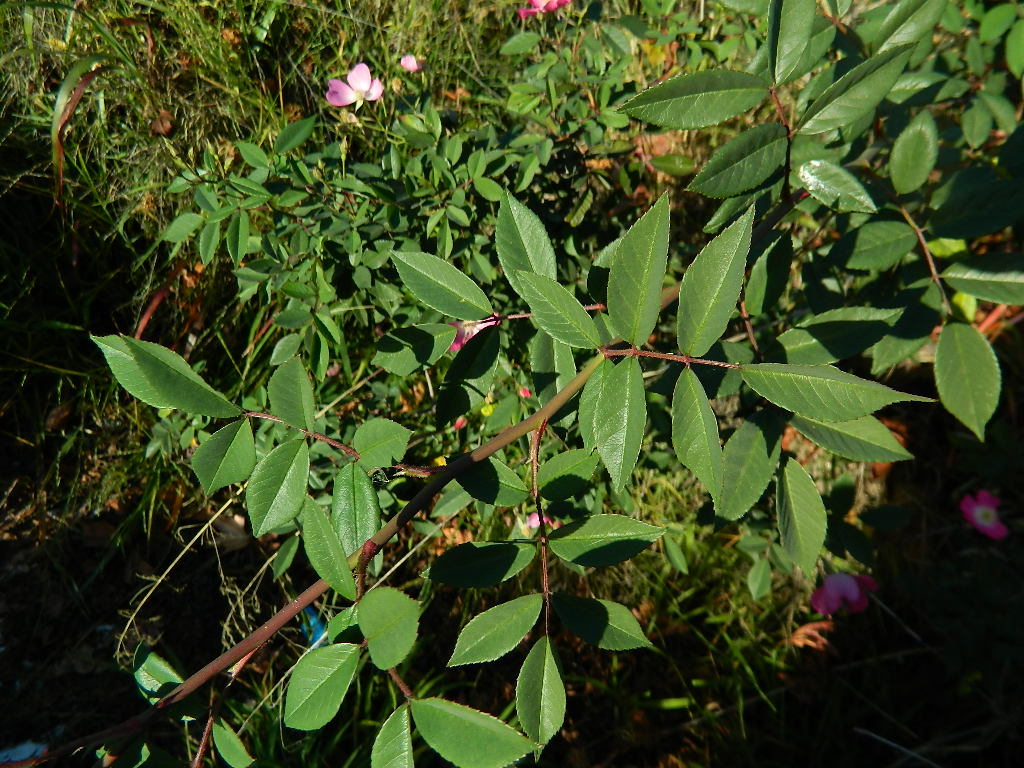
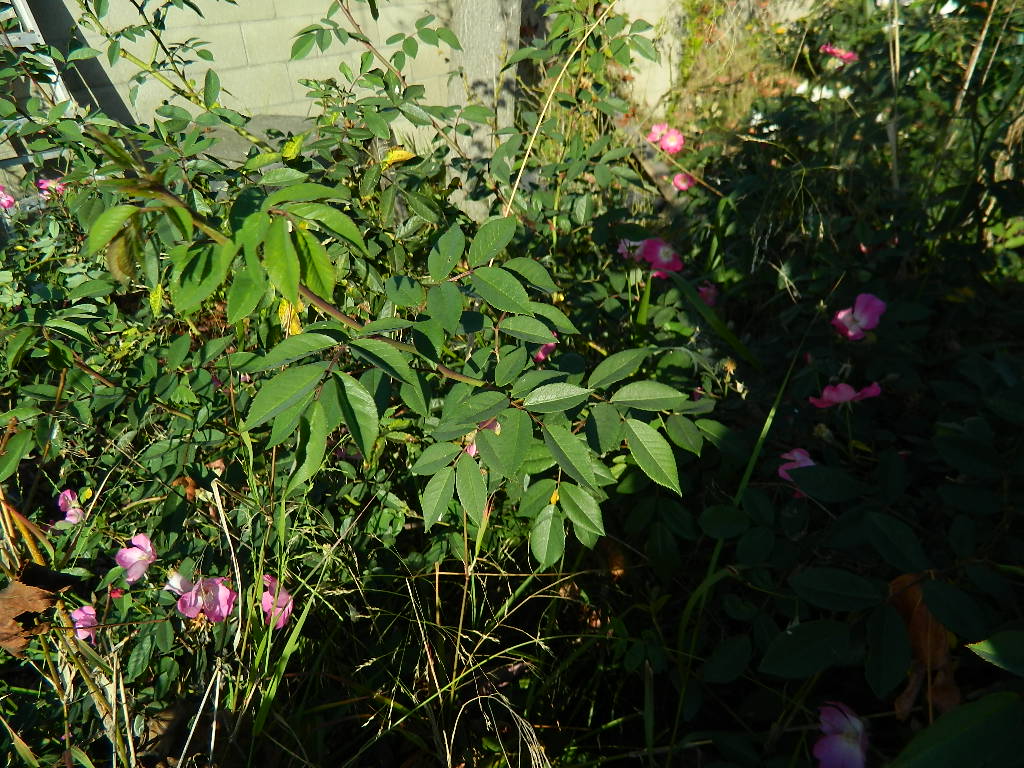
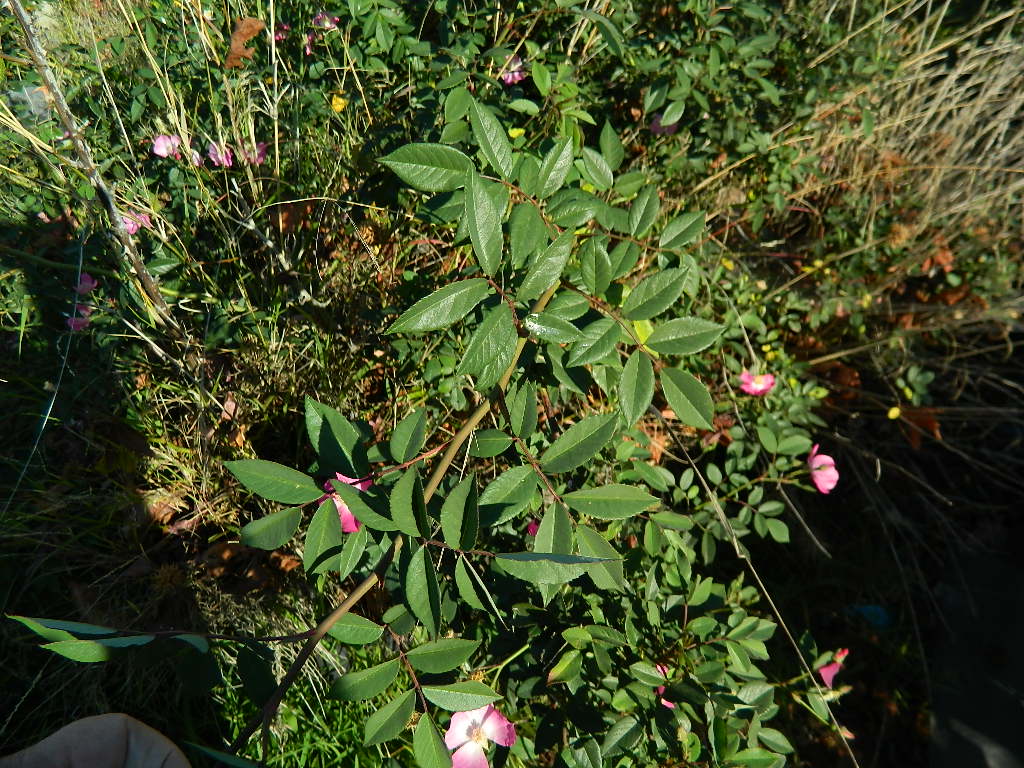
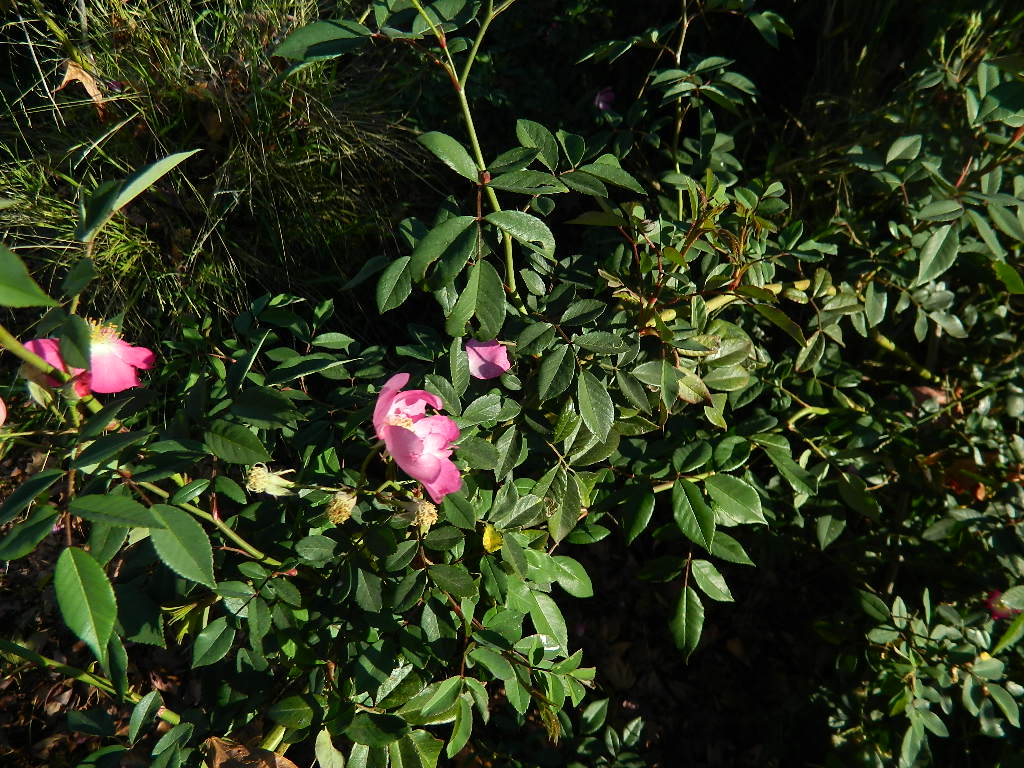
For living in an area with “not enough heat,” Kim, you sure have nice winters. Our temps are climbing 65 degrees this week, so we will have everything budding out soon only to probably be nipped in another week if history is any indication. (I don’t much care for this inland weather.)
How does Pink Clouds fare for relative drought tolerance? And how large are the plants it pushes?
We’re having a heat fluctuation this week. By Wednesday, we’ll hit 81 then back to the low 70s in a day or two. I can’t really gauge “drought tolerance”. I have to grow everything in nursery cans because of engineered soil, so I have to water regularly. Being a multiflora type, it’s roots aren’t AS woody and large as Huey’s. They’re more fibrous as befitting a traditional multiflora. How large the plants budded on it become depends more upon the genetics of the scion than Pink Clouds. I’ve seen decades old mini standards budded on it whose trunks aren’t significantly thicker than they were when originally produced. I’ve also seen 5’ weepers budded on it that were huge. This is a probably 25-ish year old Sunshine (1927 poly) standard Burling Leong produced at Sequoia on Pink Clouds. I purchased and grew in a pot on a gardening client’s patio for years until she tired of it. I removed it, took it home and planted it in the yard in Encino where it grew for a few years. When we sold and moved here, eleven years ago, I gave it to a friend in Santa Barbara. We dug it and she dragged it home and planted it. She reports the head of it is easily 5’ across.
It appears to react to what the scion demands from it, as any stock would.
Pink Clouds is definitely drought tolerant. Last year I planted a rooted cutting in a spot with terrible soil and left it to roast in 100% full sun. It’s a spot in my front yard that’s remained uncultivated because it’s so exposed to the elements that even native volunteers fail without supplemental water, and the cutting eventually went neglected because I forgot about it. Then in late summer I accidentally mowed it down flush to the ground only to discover a new shoot coming up from the ground like a month later.
I had another cutting in a one gallon pot that got knocked over by the wind underneath a a big sunflower and went maybe a month without any water in the summer heat. It defoliated but bounced back just fine. I think to kill Pink Clouds you would need to make an active effort.
I’ve read some multifloras may struggle with chlorosis in calcareous soil. Was that ever a problem with ‘Pink Clouds’? I wonder if GdR would do better, or if the so touted ‘Fortuniana’ really is the best to expect for calcareous places.
Some multiflora types will struggle with chlorosis in extreme conditions. MANY roses will. Fortuniana is vigorous but its root system is also very shallow, leaving it susceptible to mechanical damage and freezes. It’s that shallow root system which makes it “nematode resistant” because the roots remain above the level of soil in which the nematodes live. If you are someone who loves to have “companion plants”, I’d skip Fortuniana. Every damaged root provides a perfect entry point for crown gall infection. I don’t know if GdR would perform better in alkaline conditions, but it’s found in arid abandoned gardens along with other “found” roses, many of which are multiflora types which seem to not mind the alkaline soils and ground water. Go figure. I’ve never had issues with Pink Clouds and chlorosis, even when I grew it in native desert adobe in old Newhall garden as well as the ancient sea bed soil on the ridge in the Santa Monica Mountains in Encino. Plain old multiflora and The Gift both suffered chlorosis in the Newhall adobe until the copious fresh horse manure mulches I applied for years did their magic.